Here's the honest answer: rejuvenation addresses a real, documented chemical process that causes shingle failure. Lab testing supports the core mechanism. But it is not a fix for every roof, and eligibility matters more than most providers admit.
This article covers the science, the limitations, and what Phoenix-area homeowners specifically need to know before making a decision.
Key Takeaways
- Asphalt shingles lose their oils chemically long before they fail structurally — these are separate failure modes with different solutions
- Lab-tested oil-replenishment treatments measurably improve shingle flexibility and granule retention
- Phoenix's 111 days per year at or above 100°F accelerates oil depletion faster than most climates
- Rejuvenation only works on structurally sound shingles. Curled, cracked, or granule-stripped shingles need replacement, not treatment.
- A reputable provider gives you an honest assessment — if your shingles don't qualify, they'll tell you upfront
Why Asphalt Shingles Break Down Faster in Arizona
Asphalt shingles contain natural oils called maltenes that keep the asphalt binder pliable and weather-resistant. Over time, UV exposure, heat, rain, and freeze-thaw cycles cause these oils to evaporate — leaving shingles dry, rigid, and prone to cracking, curling, and granule loss. The Asphalt Institute Foundation's 2024 durability report confirms it: asphalt-binder aging causes oxidation and increased stiffness, which leads to brittleness, cracking, and loss of granule adhesion.
Phoenix Makes This Worse
Arizona's climate accelerates this process faster than most homeowners expect. NWS Phoenix climate data shows 111 days per year at or above 100°F and 21 days at or above 110°F based on 1991–2020 normals. That thermal load is sustained, not occasional.
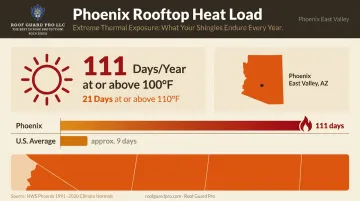
For East Valley homeowners, this means shingles on a 20-year-rated roof can begin showing meaningful oil depletion within 3–5 years of installation — well before the warranty suggests any concern.
What You Actually See
Visible symptoms of oil depletion include:
- Granules accumulating in gutters or downspouts
- Fading color or a chalky, dull surface
- Edges beginning to curl or lift slightly
- Brittleness when shingles are flexed or touched
These signs indicate chemical degradation, not necessarily structural failure. That distinction matters: shingles that have lost flexibility but retained their structure are exactly the candidates rejuvenation treatments are designed to address.
How Shingle Rejuvenation Actually Works
A penetrating oil-based treatment is applied to the shingle surface and absorbed into the asphalt layer, replenishing the oils that UV and heat have driven out. Done correctly, this restores flexibility and adhesion from within the shingle — not just at the surface.
This is fundamentally different from elastomeric or acrylic coatings, which sit on top of the shingle rather than penetrating it. ARMA (the Asphalt Roofing Manufacturers Association) explicitly advises against field-applied coatings over installed shingles due to potential effects on fire classification, moisture movement, and manufacturer warranties. A genuine rejuvenation treatment is not a coating — it's a penetrating restoration.
The GoNano Approach
Roof Guard Pro applies GoNano Shingle Saver, which uses nanotechnology to penetrate the asphalt at a molecular level. The nanoparticles are small enough to enter the shingle's asphalt pores directly — something traditional silicone or acrylic sealants cannot do because their particle size keeps them at the surface.
The practical result:
- Replenishes lost oils within the asphalt layer
- Protects against further UV degradation for the full warranty period
- Increases flexibility, reducing brittleness and susceptibility to hail and wind damage
- Repels water and inhibits algae growth through hydrophobic action
- Retains granules, preserving the shingle's built-in UV shield
The application uses low-pressure spray across the full roof surface. It's completed without tear-off or major disruption — typically in a few hours — and GoNano Shingle Saver carries a 10-year manufacturer warranty, meaningfully longer than the 5-year warranties common in the industry.
One important caveat: this works only when shingles still have structural integrity. Rejuvenation restores the chemical composition of an aging but physically intact shingle. It cannot repair a shingle that is already cracked, missing, or structurally compromised.
What the Lab Testing Actually Shows
The science behind oil replenishment is real. A 2025 Iowa State preprint tested semi-epoxidized soybean oil (SESO) emulsions on shingles aged 15+ years. The results were measurable:
| Metric | Untreated | 10% SESO | 30% SESO |
|---|---|---|---|
| Flexural modulus (aged architectural) | 26.2 MPa | 10.4 MPa | 4.5 MPa |
| Flexural strain (aged 3-tab) | 5.9% | 8.7% | 10.0% |
| ASTM D4977 grit mass loss | ~20% | ~18% | ~9% |
| ASTM E108 flame spread | ~50 inches | <20 inches | — |
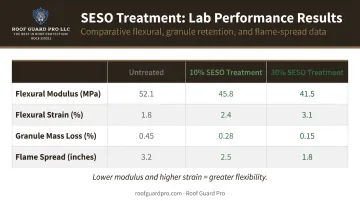
Lower flexural modulus and higher strain mean greater flexibility — a direct measure of whether the shingle can bend without cracking. Lower grit loss means granules are adhering better, which matters because granules are the shingle's primary UV shield.
Disclosure: six authors of the Iowa State preprint hold ownership stakes in SoyLei Innovations, LLC, which commercializes SESO treatment. The data is from a preprint, not a completed peer-reviewed journal article.
Those caveats don't invalidate the underlying mechanism — but they do shape how far the data can be stretched.
What the Testing Doesn't Prove
The lab data is promising, but it has real limits:
- No independent, long-term field study has verified a specific 5-, 10-, or 15-year service-life extension
- The lab testing used 48-hour heat conditioning — not multi-year outdoor exposure
- The fire test results (Intertek, ASTM E108 Class A) apply to specific products and assemblies, not all rejuvenators
The science supports the mechanism. It does not yet provide independent, long-term field data for the product category as a whole. A manufacturer warranty — such as the 10-year warranty GoNano backs its Shingle Saver treatment with — currently offers more concrete durability assurance than any published longevity study can.
Which Roofs Qualify — and Which Don't
This is where many homeowners get misled. Not every aging roof is a candidate, and a provider that treats every roof regardless of condition is a red flag.
Good Candidates
The ideal roof for rejuvenation:
- Is 12–20+ years old with shingles that still have physical integrity
- Has no active leaks or structural damage to the deck
- Shows granule loss, minor fading, or early brittleness — signs of oil depletion rather than structural failure
- Has sound underlayment and a properly installed base
In Arizona's climate, Roof Guard Pro recommends treating before visible failure sets in. The most effective window is early: shingles that are drying out but haven't yet started curling or shedding significant granules respond best to treatment.
For new roofs, GoNano Shingle Saver applied within 6–12 months of installation can lock in the factory oils before Arizona's UV environment begins depleting them, effectively extending a 20-year-warranty roof to 30–35 years of total performance.
Disqualifying Conditions
Rejuvenation is not appropriate when shingles show:
- Curling or lifting at edges — a sign of structural failure that oil replenishment can't reverse
- Significant granule loss — shingles that have shed their UV-protective layer are too far degraded to hold treatment
- Missing, cracked, or broken shingles — physical damage that requires repair or replacement first
- Active roof leaks or rotted decking underneath
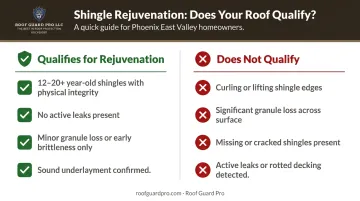
Roof Guard Pro's free onsite assessment is designed to make this call clearly. If a roof doesn't qualify, they'll say so upfront rather than apply a treatment that won't deliver results.
Rejuvenation vs. Full Replacement: The Cost Reality
The JLC 2025 Cost vs. Value Report puts the national modeled asphalt-shingle replacement cost at $31,871. In Arizona, full re-roof quotes typically run $10,000–$40,000+ depending on roof size, pitch, and material.
Rejuvenation costs a fraction of that. Roof Guard Pro prices each job based on roof square footage and shingle condition after a free onsite inspection. Call (480) 878-2238 for a no-obligation estimate.
For roofs that qualify, the numbers are straightforward:
- Extends roof life by 10+ years when shingles still have structural integrity — at a fraction of replacement cost
- Capital stays in the homeowner's pocket
- No tear-off disruption, no weeks of scheduling delays
- For HOAs managing dozens of properties, the math compounds significantly across a full portfolio
There's also an environmental case worth acknowledging: avoiding a full tear-off eliminates significant landfill waste. ARMA estimates that reclaimed shingles incorporated into asphalt mixtures in 2024 were equivalent to approximately 256,400 residential roofs. A single re-roof contributes meaningfully to that waste stream — restoration sidesteps it entirely.
What to Look for in a Provider
Rejuvenation is a growing category, and not every operator uses quality products or follows proper application procedures. Here's what separates legitimate services from the rest:
- Verify the Arizona ROC license — required for any residential contracting work. Check directly at roc.az.gov. Roof Guard Pro holds ROC# 350311.
- Certified applicator status for the specific product being applied, not just a general contractor license
- A written manufacturer warranty — GoNano's 10-year warranty is documented and transferable, not a verbal commitment
- Onsite physical inspection before treatment — any quote given over the phone without seeing the roof is a warning sign
- Willingness to turn away business when rejuvenation isn't the right call — that's the provider worth trusting
Watch for these red flags:
- Vague product claims with no third-party testing
- No Arizona contractor license or applicator credentials
- No written warranty — verbal commitments don't hold up
- Pressure to commit before an onsite inspection happens
Frequently Asked Questions
Does asphalt shingle rejuvenation really work?
Yes — the science supports the core mechanism. Lab testing shows measurable improvements in shingle flexibility and granule retention after oil-replenishment treatment. The results hold when the right product is applied by a trained professional to an eligible roof. It is not a fix for structurally failed shingles.
How much does shingle rejuvenation cost?
Pricing varies by roof size, pitch, and condition and is quoted after an onsite inspection. As a general reference, industry sources cite ranges roughly between $500 and $3,000+ for residential applications — a fraction of Arizona's $10,000–$40,000+ replacement costs. Contact Roof Guard Pro at (480) 878-2238 for a free onsite estimate.
How long does shingle rejuvenation last?
Quality treatments are designed to extend roof life by 10–15 years from a single application. The GoNano Shingle Saver carries a 10-year manufacturer warranty, longer than the 5-year warranties typical of competing products.
What makes a roof a good candidate for rejuvenation?
Shingles that are 12–20+ years old, still physically intact (no curling, cracking, or heavy granule loss), with no active leaks and a sound deck. A professional inspection is the only reliable way to confirm eligibility — condition photos or phone assessments are not sufficient.
Does shingle rejuvenation void the manufacturer's warranty?
Most penetrating, oil-based rejuvenation treatments are formulated to be compatible with existing shingle warranties rather than void them. However, warranty terms vary by shingle brand, and homeowners should confirm this in writing with their provider before treatment. Roof Guard Pro can address this question at the time of the free onsite estimate.
Is shingle rejuvenation worth it for Arizona homeowners?
Arizona's extreme heat and UV load accelerate oil depletion faster than in milder climates, making proactive treatment more valuable here than almost anywhere else. For East Valley homeowners facing $10,000–$40,000+ replacement quotes on roofs that still have structural integrity, rejuvenation extends roof life at a fraction of that cost — completed in a single afternoon, not a full tear-off.