Introduction
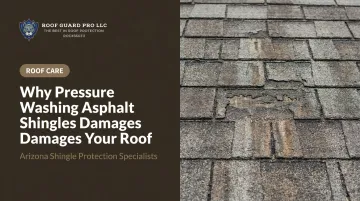
You spot dark streaks running down your roof and a few shingles buried under debris. The instinct is immediate: grab a pressure washer or hire a cleaning crew with one. It feels like the responsible thing to do.
But for Arizona homeowners with asphalt shingles, that instinct can convert a cosmetic problem into an early roof replacement — typically costing $10,000–$40,000 in the Phoenix East Valley market.
Asphalt shingles are engineered to shed water falling from above, not withstand concentrated jets fired at them from a pressurized nozzle. Rain distributes force across the entire surface; a pressure washer concentrates it into a narrow stream that shingles simply aren't designed to handle.
This article covers what makes asphalt shingles physically vulnerable, how pressure washing damages them step by step, why Arizona's climate makes every risk worse, and what to do instead.
Key Takeaways
- Consumer pressure washers output 1,700–2,030 PSI — up to 45 times the pressure of a residential water supply line
- Both ARMA and GAF explicitly warn against pressure washing asphalt shingles due to granule loss and premature failure
- Owens Corning's warranty explicitly excludes damage caused by power washing
- Arizona's thermal cycling and UV exposure leave shingles more brittle than in most other climates
- Safest cleaning approach: diluted bleach-water solution at garden-hose pressure, with no scrubbing required
Why Asphalt Shingles Are More Fragile Than You Think
Understanding why pressure washing is destructive starts with understanding what a shingle actually is.
The Layered Structure
According to ARMA (Asphalt Roofing Manufacturers Association), a fiberglass shingle consists of:
- A glass-fiber base mat for structural support
- An asphalt coating that provides waterproofing and flexibility
- A surface layer of mineral granules that blocks UV radiation and handles weather impact
- A factory-applied adhesive sealant strip that bonds each shingle to the row above, activated by solar heat
The granules are embedded in the asphalt weathering surface — not welded or mechanically fastened. They're designed to handle rainfall from above. A high-pressure stream aimed sideways at the surface is an entirely different force — one shingles were never built to resist.
How Shingles Age
Asphalt Institute Foundation research on shingle durability shows that as asphalt binder ages, it becomes stiffer and more brittle. That aging process also weakens the bond holding granules to the surface — meaning older shingles shed granules more easily and crack under mechanical force.
That matters enormously in Phoenix, where UV intensity and heat accelerate this aging process faster than in most U.S. climates.
How Pressure Washing Damages Asphalt Shingles
The pressure gap between a garden hose and a consumer pressure washer is not subtle. Residential water supply pressure runs 45–80 PSI according to municipal utility guidance. Compare that to common consumer pressure washers:
| Device | Output |
|---|---|
| Simpson Clean Machine CM61351 | 1,700 PSI |
| Ryobi 1800 PSI Electric Washer | 1,800 PSI |
| Sun Joe SPX3000 (PWMA Certified) | 2,030 PSI |
| Residential water supply | 45–80 PSI |
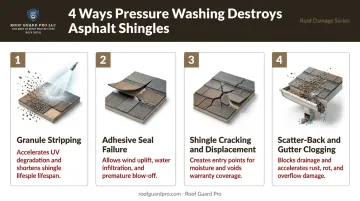
That's a force multiplier of roughly 25–45x — and shingles fail under that pressure through four distinct mechanisms, not just one:
Granule Stripping
ARMA explicitly states that pressure washing causes granule loss and is "likely to cause premature roof failure." GAF echoes this: power washing "may dislodge granules," leading to the same outcome. Granules are the primary UV shield — losing them exposes the raw asphalt to the sun, and the degradation that normally takes years happens in minutes.
Adhesive Seal Failure
Water driven sideways or upward between shingles reaches the factory adhesive strip — the same strip that provides wind resistance. Once that strip is compromised, shingles can lift during the next windstorm. In Arizona, where monsoon-season gusts regularly exceed 40 mph, that's not a theoretical risk.
Shingle Displacement and Cracking
On shingles that have already lost binder flexibility through aging, sufficient pressure can physically lift, crack, or dislodge shingles entirely. An older Phoenix roof that looks faded or dirty may be far more brittle than it appears from the ground.
The Scatter-Back Problem
Granules blasted off one area don't disappear — they redistribute across adjacent sections and wash into gutters. Clogged gutters then back up water along the fascia, and the granule-stripped zones left behind accelerate UV breakdown across the roof's most-exposed sections.
Why Arizona Homeowners Face Even Greater Risk
Asphalt shingles are sold nationwide, but the conditions they face in Phoenix are among the harshest in the country.
Thermal Cycling Weakens the Granule Bond
Phoenix's temperature swings are extreme. NWS climate normals for Phoenix Sky Harbor (1991–2020) put July's normal daily maximum at 106.5°F and minimum at 84.5°F — with January ranging from 46°F to 67.6°F. Shingles expand in the heat and contract at night, every single day. That repeated cycling weakens the mechanical bond between granules and the asphalt layer beneath them.
By the time a Phoenix roof looks visibly dirty, the granules may already be on the edge of detachment. At that point, a pressure washer provides exactly the force needed to dislodge what the climate has already loosened.
The Misdiagnosis Problem
A discolored or streaky roof in Phoenix often signals advanced binder aging — not just surface algae. Pressure washing treats the visual symptom while simultaneously accelerating the structural problem. The homeowner ends up with a briefly cleaner-looking roof that is now closer to failure, not farther from it.
Dry Climate Compounds Brittleness
Arizona's low relative humidity means shingles don't retain any residual moisture that might otherwise preserve some flexibility. The Arizona State Climate Office characterizes Phoenix as a desert climate with low rainfall, low humidity, and substantial temperature variation — conditions that compound the oil-depletion process.
That combination makes pressure washing a Phoenix-area roof far more destructive than the same action on a roof in a wetter, more temperate climate like Seattle.
Will Pressure Washing Void My Roof Warranty?
The answer depends on the manufacturer, but the risk is real.
| Manufacturer | Cleaning Guidance | Warranty Consequence |
|---|---|---|
| GAF | Garden sprayer; low-pressure rinse; do not power wash | No explicit pressure-washing exclusion in reviewed warranty language |
| Owens Corning | Follow Owens Corning algae-removal instructions | Explicitly excludes damage from power washing in warranty terms |
| CertainTeed | Professional cleaning agent; gentle removal | Generic improper-use language; no specific pressure-washing clause verified |
Owens Corning's warranty language is the clearest example: power washing damage is a named exclusion. With GAF and CertainTeed, the more general "improper maintenance" exclusions could apply depending on the circumstances and specific document version.
Warranty exposure doesn't end with the manufacturer. Homeowner's insurance — per Allstate's published guidance — covers sudden, accidental damage, not wear, tear, or improper maintenance. A homeowner who pressure-washed their roof before a leak appeared may find that sequence complicates any claim, leaving them without coverage from either source.
With Owens Corning, that exposure is explicitly documented in writing. With other manufacturers, the "improper maintenance" language is broad enough to create the same risk — just less predictably.
Safe Ways to Clean Asphalt Shingles Without Causing Damage
The Bleach-Water Method
Both ARMA and GAF converge on the same core approach, with slightly different formulations:
- ARMA: 50/50 mix of laundry-strength liquid chlorine bleach and water
- GAF: 4 gallons water, 1 gallon bleach, 1 cup TSP (or phosphate-free substitute)
Apply with a garden sprayer. Allow 15–20 minutes of dwell time. Rinse gently with a standard garden hose — never a pressure washer or stiff brush. Pre-wet and cover nearby plants before applying, and rinse any exposed vegetation with fresh water afterward.
Leaf Blower for Debris
For leaves, twigs, and loose debris, a leaf blower aimed down the slope of the roof is a zero-damage option. The directional rule matters: work with gravity, not against it. Never direct the airflow upward under shingle edges.
Get an Assessment Before Any Cleaning
This is the step most Arizona homeowners skip. A dirty-looking roof in Phoenix often warrants a structural evaluation before a cleaning crew shows up. If shingles are already curling, lifting, or losing granules — the signs of advanced binder degradation — cleaning them doesn't address the underlying problem. You need to know whether the roof is worth cleaning before you clean it.
Addressing the Root Cause
For East Valley homeowners whose shingles are losing structural oil and UV protection, that binder breakdown is the actual driver of premature aging. Roof Guard Pro's GoNano Shingle Saver addresses it at the source. Using nanosilica-modified technology recognized by the American Society of Civil Engineers, the treatment penetrates asphalt pores to replace lost oils and protect against further UV degradation — not just coat the surface like a conventional sealant.
A single application delivers:
- Restored shingle flexibility and halted granule loss
- 10–15 years of additional roof life with a 10-year GoNano manufacturer warranty
- A fraction of the cost of a $10,000–$40,000 full replacement
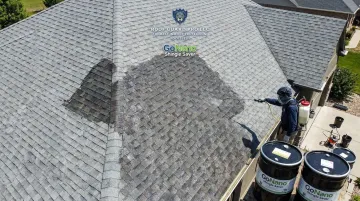
The treatment applies only to shingles that still retain structural integrity. That's why Roof Guard Pro starts every engagement with a free onsite assessment. If the roof isn't restorable, they'll say so.
Signs Your Shingles May Already Be Damaged
Visual Granule Loss
Look for:
- Granules collecting in gutters or at downspout splash zones after rain
- Bald or thin patches visible on shingles from the ground
- Uneven texture or color variation across roof sections
In Arizona, heavy granule accumulation in gutters — especially after a pressure wash or monsoon — is a signal the roof is approaching the end of its serviceable life.
Signs of Structural Failure
These require immediate professional inspection:
- Lifted or curling shingle edges
- Visible gaps between overlapping shingles
- Daylight visible in the attic
- Water stains on interior ceilings after rain
If any of these show up after a pressure washing event, the damage has gone well past cosmetic. Schedule an inspection immediately — not another cleaning.
Frequently Asked Questions
Is it okay to pressure wash asphalt shingles?
No. Both ARMA and GAF explicitly advise against it. The concentrated force strips protective granules, can break adhesive seals, and forces water between shingle layers — damage that accelerates roof failure and may not be visible until it's severe.
What is the best way to clean roof shingles?
A 50/50 bleach-water solution applied with a garden sprayer, allowed to dwell for 15–20 minutes, then rinsed gently with a standard garden hose. Get a professional assessment first to confirm the shingles have enough structural integrity to make cleaning worthwhile — and to explore whether a protective treatment like GoNano Shingle Saver is a better long-term solution than repeated cleaning.
Is it worth pressure washing your roof?
For asphalt shingle roofs, no. The short-term visual improvement comes at the cost of granule loss, potential warranty exposure, and a shortened timeline to full replacement. A protective coating applied once can preserve shingles for years — without the recurring damage that cleaning causes.
Can pressure washing void my roof warranty?
It can. Owens Corning explicitly excludes power washing damage from coverage. GAF and CertainTeed use broader improper-maintenance language that could apply. Always check your specific manufacturer's cleaning guidelines before any cleaning method.
What PSI is safe for washing asphalt shingles?
No major manufacturer publishes a safe PSI threshold for asphalt shingles — because there isn't one. ARMA says never use a pressure washer on them at all. GAF advises low-pressure water only. If cleaning is necessary, stay at garden-hose pressure with a wide, gentle spray.
How do I know if my shingles have already been damaged by pressure washing?
Check gutters for excessive granule accumulation, look for bald patches or uneven texture on the roof surface, and inspect shingle edges for curling or lifting. Any interior water staining needs prompt attention. If you see these signs, schedule a professional inspection rather than another cleaning.