Introduction
Here's a scenario that plays out thousands of times a year: a homeowner notices a water stain on the ceiling, calls a roofer, and gets quoted $12,000 for a full replacement — when a $400 flashing repair would have solved the problem. The opposite happens just as often: patch after patch on a roof that needed replacing three years ago, each repair buying a few months before the next call.
Misreading the signs in either direction is expensive. Premature replacement wastes money on a roof that had years left. Delaying replacement turns a manageable problem into structural damage and mold remediation bills.
This guide breaks down exactly which warning signs point to repair, which ones mean replacement is unavoidable, and how to make the call for your specific situation.
Key Takeaways
- Localized damage, single-source leaks, and roofs under 15 years old are typically strong repair candidates
- Widespread shingle deformation, structural deck damage, or a roof at or past its expected lifespan usually warrants full replacement
- Age alone doesn't determine the outcome; condition, damage extent, and material type all play a role
- A third option exists: nano-coating treatment that restores shingle integrity and extends a sound roof's lifespan by 10–15 years
How Long Does a Roof Actually Last?
The NRCA states that most new roofs are designed to provide useful service for about 20 years, with slate, clay tile, and certain metal systems lasting significantly longer (slate up to 100 years, clay tile around 50, metal 40–70 years). Asphalt shingles account for more than 80% of all residential roofing installed in the US, so that 20-year baseline applies to the vast majority of homes.
That number assumes reasonable maintenance conditions. Two factors consistently shorten that window:
- Poor attic ventilation — ARMA's guidance confirms that improper ventilation causes premature aging and deterioration of both structural components and shingles. The minimum benchmark is 1 sq. ft. of net free ventilation area per 300 sq. ft. of attic space.
- UV exposure and oil depletion — CertainTeed notes that UV rays degrade the protective granules embedded in shingles, exposing the asphalt underneath to brittleness and cracking over time.
A roof nearing 20 years isn't automatically a replacement candidate. But the math shifts at that age — every repair decision should be weighed against the full cost of replacement, and a professional inspection becomes essential before committing to either path.
Signs Your Roof Needs Repairs (Not a Full Replacement)
These signs indicate damage is localized, the structural deck underneath is intact, and the roofing system still has meaningful service life remaining.
Isolated Missing or Cracked Shingles
GAF confirms that missing shingles need to be replaced but are not necessarily an emergency. A few missing or cracked shingles in a contained area — especially on a roof under 15 years old — are prime candidates for spot repair, provided the surrounding shingles are still flat, granule-covered, and lying sealed against the deck.
Minor or Single-Point Leaks
A leak that can be traced to one specific failure — a cracked pipe boot, separated chimney flashing, or a lifted shingle edge — is a repair problem, not a replacement problem. The key distinction comes down to where the water appears inside:
- Single stain in one area: Points to an isolated failure — repair territory
- Staining across multiple rooms or ceiling zones: Suggests systemic roof failure, not one weak point
Flashing Failures Around Penetrations
NRCA's Roof Builders Handbook identifies flashing as the critical barrier where roofing meets walls, skylights, chimneys, vents, and other penetrations. When the shingles and membrane are intact but flashing has corroded or separated, repair is the right call. Replacing a full roof because of a flashing failure is like replacing your entire plumbing system because of a leaky faucet fitting.
Early Granule Loss in Isolated Areas
Some granule loss is a normal part of shingle aging. GAF's technical guidance notes that new shingles often shed excess granules in the first months after installation — that's not a warning sign. What matters is pattern and location. If granule loss is limited to one slope or one section rather than spread across the entire roof surface, targeted repair combined with a protective treatment can restore performance.
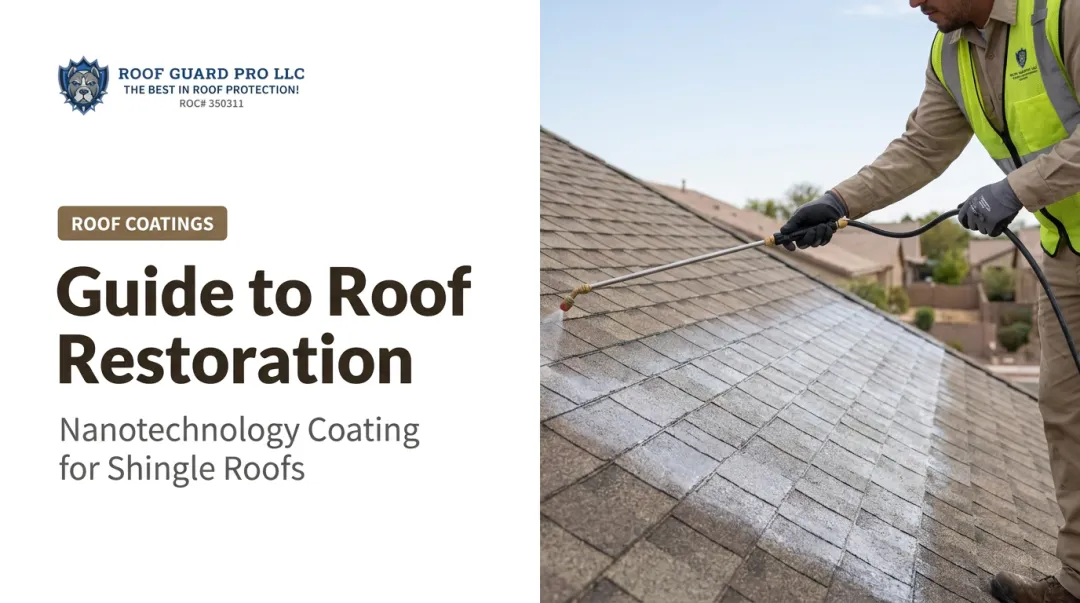
When granules shed, the asphalt layer underneath is directly exposed to UV radiation. This is where a nano-coating treatment like GoNano Shingle Saver can make a practical difference — its nanoparticles penetrate into asphalt pores to replenish lost oils and block further UV damage, going deeper than surface-level silicone or acrylic sealants.
Post-Storm Damage on an Otherwise Healthy Roof
Hail, wind, or falling debris can damage a section of a roof that was otherwise in solid condition. If the storm event is isolated and the damage is concentrated in one area, insurance-covered repair or targeted section replacement is typically the right move — provided a professional inspection confirms the rest of the roof is sound.
Signs Your Roof Needs Full Replacement
These signs indicate the roofing system as a whole is failing — either structurally, systemically, or because the materials have exhausted their protective capacity. Repairs in these scenarios delay the inevitable.
Roof Age at or Past Its Expected Lifespan
A 20-year-old asphalt shingle roof — the most common material — is likely to develop new failures after any individual repair. At that point, you're paying to maintain a system in decline, not restore a functional one. Each repair buys a little time, not a solution.
Widespread Shingle Curling, Cupping, or Clawing
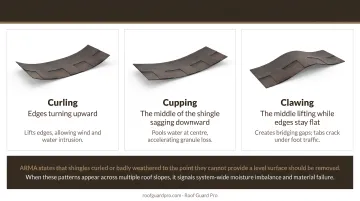
InterNACHI's inspection standards define three distinct shingle deformation types:
- Curling — edges turning upward
- Cupping — the middle of the shingle sagging downward
- Clawing — the middle lifting while edges stay flat
ARMA states that shingles curled or badly weathered to the point they cannot provide a level surface should be removed. When these patterns appear across multiple roof slopes rather than in an isolated patch, it signals system-wide moisture imbalance and material failure — not something patchwork repairs can address.
Sagging or Uneven Roof Lines
Visible sagging in the roof deck or ridge line is a structural problem, not a shingle problem. It means the decking beneath the shingles has rotted or weakened from prolonged moisture exposure. Surface repairs won't fix a compromised deck. The deck itself must be replaced along with the roofing surface, and by the time sagging is visible from the ground, full replacement is the only practical option.
Extensive Interior Water Damage or Mold in the Attic
Water stains on ceilings in multiple rooms — or an attic revealing mold on rafters, wet insulation, and daylight through the decking — mean the roof has been leaking long enough to cause secondary structural damage. This isn't a one-spot failure. The damage points to a system that has been breaking down for months, possibly longer.
Repair Fatigue
If you've called a roofer two or more times in the past three years to fix different areas, the roof is telling you something. Each new repair only delays the next failure because the underlying materials are deteriorating system-wide.
According to HomeAdvisor, roof repairs average $1,171, with a typical range of $394–$1,963. Once you've paid that two or three times over, the financial case for replacement becomes hard to ignore.
The Repair vs. Replacement Decision Framework
Four questions give you a clear path forward.
The Age + Condition Combination
Age amplifies every sign of damage. A 10-year-old roof with significant storm damage may still be a repair candidate if the deck is structurally sound. A 20-year-old roof with only minor visible damage may be a replacement candidate because of what's happening beneath the surface — brittleness, oil depletion, and sub-surface moisture infiltration that a ground-level inspection won't reveal.
The 25% Damage Threshold
Most building codes — including Arizona's — restrict how much of a roof can be repaired or recovered within a 12-month period before the entire system must be brought up to current code. The widely accepted industry boundary sits at 25%: once damage reaches or exceeds a quarter of the roof surface, replacement becomes the more practical choice.
Beyond the code threshold, systemic damage rarely stays contained. Patching one section often reveals deterioration in adjacent areas.
Comparing Repair Costs to Replacement Costs
According to HomeAdvisor's 2026 cost data, here's what you're comparing:
| Service | Typical Cost Range | Average |
|---|---|---|
| Asphalt shingle replacement | $6,134–$13,982 | $10,057 |
| Minor-to-moderate repairs | $394–$1,963 | ~$1,200 |
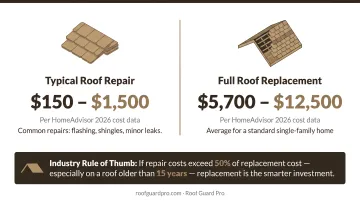
A common industry rule of thumb: if repair costs exceed 50% of what replacement would cost — especially on a roof older than 15 years — replacement is the smarter investment.
Get a Professional Inspection Before Deciding
Never make a repair vs. replace decision from the ground. A professional inspection assesses deck condition, attic moisture levels, and overall system integrity — the factors that determine whether damage is localized or systemic. InterNACHI's inspection standards confirm that ground-level checks are limited to visible exterior conditions and cannot verify deck stability or attic moisture levels.
Get at least one independent inspection before committing to either path.
How Roof Guard Pro Can Help Extend Your Roof's Life
Not every aging roof is a replacement candidate. The scenario that often gets missed: a roof that's 12–15 years old, structurally sound, but showing early signs of UV degradation — slight granule loss in spots, some brittleness, fading color. The deck is fine. The structure is solid. But the shingles are losing the oils that keep them flexible and protective.
This is exactly the scenario GoNano Shingle Saver is built for.
Roof Guard Pro applies GoNano Shingle Saver as a professional nano-coating treatment that works differently from conventional surface sealants. Its nanoparticles penetrate deep into asphalt pores, replacing lost oils and rebuilding protection from the inside out. A treated roof gains:
- Restored shingle flexibility
- A hydrophobic barrier against moisture infiltration
- Renewed resistance to UV damage and granule loss
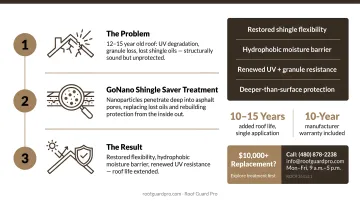
One application can add 10–15 years to a structurally sound shingled roof, backed by a 10-year manufacturer warranty. For a homeowner facing a $10,000+ replacement quote on a roof that still has structural integrity, that's a meaningful alternative to explore before committing to a full replacement.
Roof Guard Pro holds ROC license #350311 and operates in the Phoenix metro area. To find out whether your roof is a candidate for protective treatment:
- Call: (480) 878-2238 (Monday–Friday, 9 a.m.–5 p.m.)
- Email: info@roofguardpro.com
Frequently Asked Questions
Frequently Asked Questions
How do I tell if my roof needs replacing?
Look for age at or past 20 years, shingle curling or cupping across multiple slopes, a visibly sagging deck or ridge line, and water staining on ceilings in more than one room. Recurring repairs to different areas within a short period are another strong signal that the system is failing broadly, not at a single point.
Is roof replacement considered maintenance?
No. Full roof replacement is a capital improvement — the IRS classifies it as an addition to your home's cost basis. Routine maintenance covers inspections, minor repairs, flashing reseals, and cleaning, all of which preserve existing condition rather than overhaul the system.
What should I avoid saying to a roof insurance adjuster?
Don't speculate on the cause of damage, admit to deferred maintenance, or accept a verbal assessment without written documentation. Have a licensed contractor present during the inspection and request a written scope of damage before agreeing to any settlement figure.
Can a roof be repaired instead of replaced?
Yes, if damage is localized, the structural deck is sound, the roof is under 15 years old, and less than roughly 25% of the surface is affected. Only an in-person professional inspection can confirm whether repair is viable for your specific situation.
How much does roof repair cost compared to full replacement?
Per HomeAdvisor's 2024 data, repairs typically run $394–$1,963 (average $1,171), while full asphalt shingle replacement averages $10,057, with most projects ranging $6,134–$13,982. On a roof already past 15 years, accumulated repair costs can quickly approach replacement cost — making full replacement the smarter long-term investment.
What is the average lifespan of an asphalt shingle roof?
The NRCA states most new roofs are designed to provide useful service for about 20 years. UV exposure, poor attic ventilation, and natural oil depletion in shingle fibers can shorten that window. Protective treatments applied while the roof is structurally sound can help extend useful life toward or beyond the rated lifespan.