Introduction
Your driveway, walkway, and porch take a beating every day — UV rays, rain, oil spills, foot traffic, and in some climates, freeze-thaw cycles and de-icing salts. Most homeowners don't give concrete surfaces much thought until cracks appear or the surface starts flaking. By then, repair costs climb fast.
The right treatment applied at the right time can extend the life of your concrete significantly and restore its appearance — often at a fraction of replacement cost.
According to Concrete Network, professional driveway sealing runs $1 to $2 per square foot, while a new concrete driveway costs $5 to $8 per square foot plus roughly $1 per square foot for tear-out. That cost gap makes preventative treatment one of the smarter decisions a homeowner can make.
Understanding your options is the first step. This guide covers the main types of concrete surface treatments, how to prepare your surface correctly, how to choose the right product, and when hiring a professional makes more sense than going DIY.
Key Takeaways
- Untreated concrete absorbs water, oil, and chemicals, which leads to erosion, staining, and costly repairs over time
- Penetrating sealers work from within; topical coatings shield from above — your surface type and goals determine which fits
- Surface prep determines whether any treatment succeeds or fails
- Arizona homeowners should skip standard epoxies on exposed surfaces; UV stability is non-negotiable in this climate
- The "bead test" tells you exactly when to reseal — no guesswork required
What Is a Concrete Surface Treatment and Why Does It Matter?
A concrete surface treatment is any product or process applied to hardened concrete to modify its performance, appearance, or durability. Options span from thin penetrating sealers that react chemically inside the concrete's pores to thick coatings that build an entirely new wear layer on top.
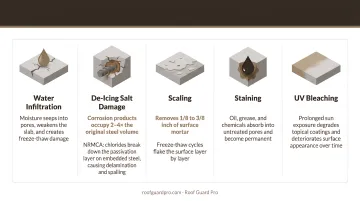
Without treatment, concrete is vulnerable to several specific failure modes:
- Water infiltration — moisture seeps in, weakens the slab, and creates freeze-thaw damage
- De-icing salt damage — according to NRMCA, chlorides from de-icing salts can break down the passivation layer on embedded steel, and corrosion products occupy 2 to 4 times the original steel volume — causing delamination and spalling
- Scaling — freeze-thaw cycles can remove 1/8 to 3/8 inch of surface mortar, flaking it away layer by layer
- Staining — oil, grease, and chemicals absorb into untreated pores and become permanent
- UV bleaching — prolonged sun exposure degrades topical coatings and can deteriorate surface appearance over time
Two Fundamental Categories
Every treatment fits one of two categories — and understanding which you're dealing with shapes every decision from product selection to application:
- Penetrating treatments — absorb into the concrete, react chemically within the pores, and protect from the inside without changing appearance
- Topical treatments — form a protective film on top of the concrete, visible to varying degrees, adding a surface wear layer
Types of Concrete Surface Treatments
Penetrating Sealers
Penetrating sealers — silane, siloxane, and silicate densifiers — work by absorbing into the concrete's pores and chemically reacting with the material itself. The result is a surface that repels water and resists chloride infiltration without changing how the concrete looks.
Performance benchmarks from Sika's Sikagard H 1000 silane-siloxane product show 80%+ water repellency, an average penetration depth of 0.35 inches (9 mm), and coverage rates of 250 to 400 sq ft per gallon — numbers that put the performance of quality penetrating sealers in concrete terms rather than marketing language.
Best for: driveways, walkways, and exterior slabs where water repellency and freeze-thaw protection are the priority.
Topical Sealers and Coatings
Topical treatments form a visible film on the concrete surface. Three main types dominate the residential market:
| Type | Best For | UV Caution |
|---|---|---|
| Acrylic sealer | Decorative/stamped concrete, exterior slabs | UV-resistant formulas available |
| Epoxy coating | Garage floors (interior) | Yellows under UV — interior use only |
| Polyurethane coating | Surfaces needing abrasion and chemical resistance | Better UV stability than epoxy |
One critical note for Arizona homeowners: standard epoxy sealers can yellow and amber with UV exposure and are generally limited to interior use. On exposed driveways or porches, they're the wrong call.
Decorative Finishes
For homeowners who want appearance improvements alongside protection, decorative treatments include:
- Acid staining: creates variegated, mottled color through a chemical reaction unique to each slab
- Concrete dyes: more color-consistent than acid stains, with faster application
- Stamping and stenciling: pattern textures applied during or after placement
Keep in mind: decorative finishes are not protective treatments on their own. Nearly all of them require a topical sealer on top to protect the finished surface from wear, moisture, and staining.
Resurfacing and Overlays
When a slab is structurally sound but visually damaged — pitting, surface erosion, or worn appearance — resurfacing is the cost-effective middle ground between sealing and replacement.
Products like Quikrete Re-Cap apply from 1/16 inch to 1/2 inch thick. More substantial overlays (like CTS TRU PC) require 3/8 inch to 1.5 inches of thickness and a primed substrate. Overlay costs range from $3 to $7 per square foot for basic finishes, up to $20+ for high-end decorative work — still less than full replacement in most cases.
Nanotechnology-Based Treatments
Nano-based concrete sealers represent a newer category that works at a molecular scale. Rather than sitting on top of the surface or penetrating only a few millimeters, nanotechnology-based products fill pores from deep within the concrete matrix — providing stain resistance and water repellency that standard sealers often can't replicate.
Roof Guard Pro applies GoNano Concrete Saver, a nanotechnology-based treatment designed specifically for driveways, walkways, and porches. GoNano's nanoparticles penetrate deeper than conventional silicone or acrylic products, filling pores from within rather than coating from above. The result is stain prevention and elemental protection built into the concrete itself, not layered on top.
Best for: driveways, walkways, and porches in high-UV climates where surface coatings degrade quickly.
How to Prepare Your Concrete Surface for Treatment
Surface preparation is the single biggest factor determining whether a treatment works or fails. A sealer applied over dirty, oily, or damp concrete will fail regardless of product quality — this is where most DIY treatments go wrong.
Step-by-Step Preparation
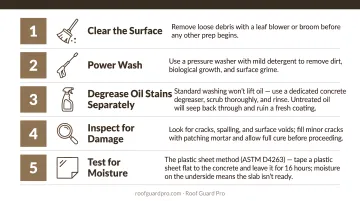
- Clear the surface: Remove loose debris with a leaf blower or broom.
- Power wash: Use a pressure washer with mild detergent to remove dirt, biological growth, and surface grime.
- Degrease oil stains separately: Standard washing won't lift oil — use a dedicated concrete degreaser, scrub thoroughly, and rinse. Untreated oil will seep back through and ruin a fresh coating.
- Inspect for damage: Look for cracks, spalling, and surface voids; fill minor cracks with patching mortar and allow full cure before proceeding.
- Test for moisture: The plastic sheet method (ASTM D4263) works well for homeowners — tape a plastic sheet flat to the concrete and leave it for 16 hours; moisture on the underside means the slab isn't ready.
The Dew Point Factor
Once your surface passes the prep checklist, environmental conditions become the next variable to control. If the surface is too cold or the air is too humid, condensation forms on the concrete and causes the treatment to bond poorly or peel.
In Arizona's climate, cooler mornings in fall, winter, and early spring typically offer the best conditions for acrylic sealer application — avoid midday heat or periods following overnight rain. Check the product's technical data sheet for specific temperature and humidity thresholds before you start.
How to Choose the Right Treatment for Your Concrete Surface
Three factors drive the right decision:
- Surface location — indoor vs. outdoor, exposed vs. covered
- Primary concern — water protection, stain resistance, appearance, or anti-slip
- Visibility preference — invisible protection vs. a visible finish change
Decision Framework
| Surface | Recommended Treatment |
|---|---|
| Outdoor driveway or walkway | Penetrating silane/siloxane sealer or nano-treatment |
| Stamped or decorative patio | Acrylic or polyurethane topical sealer |
| Garage floor (interior) | Epoxy or polyaspartic coating |
| Damaged but structurally sound slab | Resurfacing overlay, then seal |
| Covered porch | Topical sealer or nano-treatment depending on exposure |
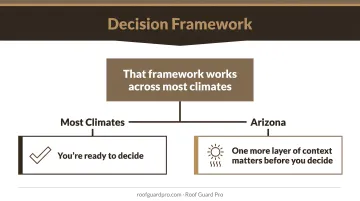
That framework works across most climates — but if you're in Arizona, one more layer of context matters before you decide.
Climate Considerations for Arizona
Arizona's climate creates specific challenges that differ from freeze-thaw states. UV intensity in the Phoenix area is high enough to degrade many standard coatings over time. Priorities for Arizona homeowners:
- Avoid standard epoxies on any exposed outdoor surface — yellowing is predictable, not rare
- Choose UV-stable formulas for any topical sealer on porches, walkways, or driveways
- Consider penetrating or nano-based treatments where an invisible, durable solution is preferred — these don't rely on a surface film that can degrade under prolonged sun exposure
W.R. Meadows' ARIZONA SEAL is specifically formulated as a non-yellowing acrylic polymer for this climate — one example of what a genuinely UV-resistant product looks like. For homeowners who prefer a professionally applied nano-based option, services like Roof Guard Pro's Concrete Saver deliver that same no-film, no-yellowing durability without the DIY application.
The Role of Sealers in Long-Term Concrete Maintenance
Even well-applied sealers wear down over time. High-traffic driveways and walkways exposed to Arizona's UV intensity and temperature swings put extra stress on surface protection — so knowing when to reapply matters.
General reapplication intervals:
- Topical acrylic sealers: every 1–3 years depending on traffic and weather
- Quality penetrating sealers: 5–10 years, with some products lasting longer on low-traffic surfaces
The Bead Test
Those intervals are estimates — actual wear depends on your specific surface and conditions. The most reliable way to check is the water drop test, recommended by Concrete Network: pour a small amount of water on the surface and watch for 30–60 seconds. If it beads up, protection is still active. If it absorbs, it's time to reseal.
A simple maintenance routine:
- Annual visual inspection for surface wear, flaking, or erosion
- Prompt stain cleaning before contaminants penetrate
- Bead test each spring to check whether reapplication is needed
Staying on top of these checks is far cheaper than grinding, etching, or re-coating a surface that's deteriorated to bare concrete.
DIY vs. Hiring a Professional for Concrete Surface Treatment
What Homeowners Can Reasonably DIY
- Cleaning and power washing before treatment
- Basic acrylic sealer application on small patios or walkways using a roller or sprayer
- Applying concrete dye on manageable interior surfaces
That said, DIY errors on decorative or larger surfaces are often costly and hard to reverse:
- Uneven sealer application leaves visible lap marks
- Over-application traps moisture beneath the surface
- Under-application leaves gaps in coverage that defeat the purpose
When Professional Application Makes Sense
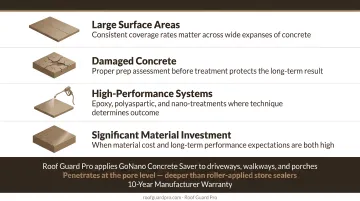
- Large surface areas where consistent coverage rates matter
- Damaged concrete requiring proper prep assessment
- High-performance systems — epoxy, polyaspartic, nano-treatments — where technique determines outcome
- Any surface where the treatment involves significant material cost and long-term performance expectations
For Arizona homeowners looking for a professional option, Roof Guard Pro applies GoNano Concrete Saver to driveways, walkways, and porches. The treatment uses nanotechnology to penetrate concrete at the pore level — deeper than roller-applied store sealers reach — and carries a 10-year manufacturer warranty.
Questions to Ask Before Hiring Any Contractor
- Are you licensed with the Arizona ROC? (Roof Guard Pro holds ROC# 350311)
- What surface preparation do you perform before applying treatment?
- What product are you using and does it carry a manufacturer warranty?
- Can you provide references for similar concrete surfaces?
Frequently Asked Questions
Is concrete resurfacing a good idea?
Resurfacing is a cost-effective choice when the slab is structurally sound but visually damaged. At $3 to $10 per square foot for resurfacing vs. $5 to $8 per square foot plus ~$1 for tear-out for replacement, the savings are real. It won't fix slabs with serious structural failures — those need replacement.
How do I make my concrete surface look better?
Cleaning and sealing is the fastest way to restore color and sheen. If you want a new look, staining or dyeing adds color while stamping or stenciling adds pattern. Severely worn surfaces benefit most from resurfacing — the biggest visible improvement short of full replacement.
Does concrete coating really work?
Concrete coatings work well on properly prepared surfaces. Longevity depends on prep quality, coating type, traffic levels, and periodic reapplication. Coatings applied over dirty or damp concrete will fail.
How often should concrete surfaces be sealed?
Topical sealers typically need reapplication every 1–3 years; quality penetrating sealers can last 5–10 years. The practical indicator: if water no longer beads on the surface within 30–60 seconds, it's time to reseal.
What is the difference between a concrete sealer and a concrete coating?
Penetrating sealers work inside the concrete's pores with little visible change, while coatings form a film on top that alters appearance and adds surface-level protection. Sealers generally require less maintenance; coatings offer more finish options.
Can I apply a new treatment to old or previously sealed concrete?
Yes, with conditions. Old coatings may need to be removed or abraded first for proper adhesion. Penetrating sealers generally won't work on previously coated surfaces — the film blocks pore access. Test adhesion before committing to a full application.