According to a 2024 Hanover Insurance Group/Harris Poll report, nearly 60% of homeowners had not inspected their roof for damage in the prior year, and 8% had no idea how old their roof even was. NAHB's research puts the average asphalt shingle roof life expectancy at approximately 20 years — but that's a national average across vastly different climates.
In Arizona, the variables that govern real-world lifespan stack against you. UV intensity, extreme heat, and monsoon season combine to age shingles faster than any rating system accounts for.
This article breaks down what actually determines shingle lifespan, what's accelerating the aging process on your roof right now, how to spot the warning signs, and what options exist beyond a full replacement.
Key Takeaways
- Warranty ratings overstate real-world lifespan — climate, ventilation, and installation quality determine when your roof actually fails
- Phoenix's UV intensity and heat cycling compress shingle life well below manufacturer estimates
- Granule loss, curling, and brittleness signal oil depletion, not surface aging you can ignore
- Structurally intact roofs can gain 10–15 years with a single GoNano Shingle Saver application — no replacement needed
- Schedule annual inspections after year 15 to catch oil depletion early and avoid a $10,000–$40,000 replacement
How Long Do Asphalt Shingles Last? A Look by Shingle Type
Not all asphalt shingles are the same product. There are three distinct categories, and their construction differences matter for durability.
The Three Types
| Shingle Type | Construction | General Lifespan Range |
|---|---|---|
| 3-tab | Single layer, flat profile | ~15–20 years |
| Architectural (dimensional) | Multi-layer, textured profile | ~20–30 years |
| Premium/luxury | Thick multi-layer, complex profile | ~25–40 years |
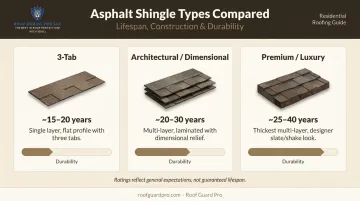
These ranges reflect general industry expectations, not guaranteed service life. Warranty terms from manufacturers like GAF and CertainTeed describe coverage against manufacturing defects — GAF's Royal Sovereign 3-tab carries a 25-year limited warranty, while architectural and premium products often carry "Lifetime" limited warranties. Those are defect warranties, not predictions of how long the shingle will function in the field.
The NAHB puts the industry-average expected life at approximately 20 years across all types, with installation quality, climate, and maintenance identified as the major variables.
Why Construction Thickness Matters
Architectural and premium shingles use multi-layer laminated construction. More asphalt mass means:
- More material for UV to deplete before reaching the base layer
- Better resistance to wind lift and mechanical stress
- A thicker granule layer that stays bonded longer
The biggest upgrade most homeowners can make at replacement time is switching from 3-tab to architectural shingles. The cost difference is real but modest — architectural shingles typically run $0.50–$1.50 more per square foot installed, yet deliver 5–10 additional years of service life in Arizona's UV-intense climate.
What Actually Causes Asphalt Shingles to Wear Out
Most roof problems trace back to a single root cause. Once you understand it, the warning signs become easy to recognize — and so does the window for acting before replacement becomes unavoidable.
The Core Problem: Binder Degradation
Asphalt shingles contain organic binder compounds that keep the material flexible and waterproof. UV radiation and heat exposure break these compounds down over time, causing shingles to progressively lose flexibility, become brittle, and crack. The Asphalt Institute Foundation treats binder aging as a measurable material problem — one that progresses faster depending on how much UV and heat a roof absorbs each year. Nearly every visible sign of roof aging starts here.
Granule Loss: The UV Shield Eroding
GAF's technical documentation confirms that the mineral granules embedded on shingle surfaces hold the asphalt coating and help prevent UV degradation. Federal weathering research supports this: granules absorb most incident UV on a well-designed shingle, shielding the asphalt below.
As granules loosen and wash away over years of exposure, bare asphalt is increasingly exposed to direct sun — accelerating binder breakdown. An early check: look in your gutters after rain. Granule accumulation there is one of the earliest measurable warning signs.
Attic Ventilation: A Hidden Multiplier
Poor attic ventilation traps heat, creating a second source of thermal stress on shingles from below.
GAF's technical bulletin on attic ventilation confirms that excess attic heat can contribute to moisture buildup and potential roofing product or structural damage. CertainTeed's warranty terms go further: roofs installed on inadequately ventilated decks typically receive a reduced 10-year limited warranty period rather than full coverage.
In Arizona's climate, where attic temperatures can exceed 150°F in summer, this thermal stress is far more severe than in temperate regions. Balanced intake and exhaust airflow matters — both for shingle life and warranty protection.
Installation Quality and Storm Exposure
Both of these factors compound binder degradation, often pushing a roof toward failure years ahead of schedule:
- Installation errors — Improper nail placement, incorrect overlap dimensions, and reused flashing create moisture entry points and mechanical vulnerabilities that surface months or years later, often after the installation crew is long gone
- Storm damage — Hail dislodges granules, high winds stress adhesive seals, and repeated thermal cycling from day-to-night temperature swings weakens shingle bonds over time
Arizona's Climate: Why Phoenix Roofs Age Faster
UV exposure, heat cycling, and storm stress affect roofs everywhere. In Phoenix's East Valley, they hit at an intensity that compresses a shingle's lifespan by years — sometimes a decade or more.
UV and Sunshine Exposure
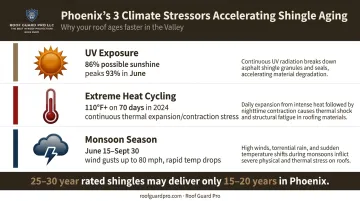
The Arizona State Climate Office reports that Phoenix averages 86% of possible sunshine, peaking near 93% in June. That's among the highest sustained sun exposure of any major U.S. city. Since UV radiation drives binder degradation and granule loosening, a Phoenix roof absorbs more of both every single day than roofs in most of the country.
Extreme Heat Cycling
Under National Weather Service 1991–2020 normals, Phoenix's first day at or above 110°F typically falls on June 11, with the last occurring around August 26. In 2024, Phoenix reached at least 110°F on 70 separate days.
That sustained extreme heat — combined with significant nighttime cooling — creates continuous thermal expansion and contraction stress across the entire summer. Each cycle stresses adhesive seals and shingle bonds, and a single Phoenix summer delivers more of those cycles than a moderate-climate roof might face across several years.
Monsoon Season: A Secondary Stressor
Arizona's official monsoon season runs June 15 through September 30. What's notable isn't just the rainfall — it's rapid temperature drops, wind-driven debris, and intense brief rain events hitting shingles already weakened by months of UV and heat.
Wind events compound the damage. A July 24, 2024 Phoenix microburst produced measured gusts of 59 mph, with radar velocities exceeding 70 mph and NWS-estimated localized winds of 70–80 mph near the most significant damage.
The Practical Implication
A shingle product rated for 25–30 years in a temperate U.S. climate may realistically deliver 15–20 years in Phoenix's East Valley. Arizona sits far outside the conditions those ratings assume. Plan inspection and maintenance timelines around Phoenix's actual climate, not the warranty brochure's projections.
Key adjustments for East Valley homeowners:
- Schedule professional roof inspections every 3–5 years (not at the 10-year mark most warranties suggest)
- Check for granule loss and binder dryness after each monsoon season
- Factor a 15–20 year realistic lifespan into any roof replacement or treatment budget
Warning Signs Your Shingles Are Aging
Most shingle problems show up visually before they show up as water damage inside your home. Knowing what each sign means — and how serious it is — determines whether you're looking at a repair, a protective treatment, or a full replacement.
Visual Signs from the Ground
Watch for these from the ground or during a gutter cleanout:
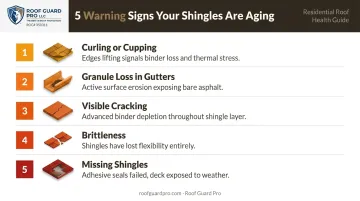
- Curling or cupping — upward curl at shingle edges (cupping) or downward curl at the center (clawing) signals binder loss and thermal stress; a curled shingle is no longer sealing along its edges
- Granule accumulation in gutters — significant granule buildup after rain means active surface erosion; the more bare asphalt exposed, the faster degradation accelerates
- Visible cracking — cracks seen from the ground indicate advanced binder depletion throughout the shingle layer
- Brittleness — shingles that snap easily when touched have lost flexibility entirely
- Missing shingles — adhesive seals have failed, leaving the deck directly exposed to weather
Interior Warning Signs
Interior signs often lag surface deterioration by months — which is why they're alarming when they appear:
- Water stains on ceilings or attic sheathing
- Visible daylight through roof boards when inside the attic
- A spike in cooling bills (shingle system no longer performing thermally)
- Mold or mildew in the attic
"Extend" vs. "Replace": The Critical Fork
This distinction matters more than most homeowners realize:
- Replace: Multiple warning signs across the entire roof surface, structural deck compromised, or shingles that have already curled, lifted, or lost granular structure
- Extend: Early-to-mid stage degradation with structurally intact shingles and sound decking — a professional assessment can determine whether a protective treatment like GoNano Shingle Saver is the right call — one application can add 10–15 years to a roof that still has structural integrity, at a fraction of replacement cost
Most homeowners don't know the extend option exists. By the time a contractor walks the roof, the conversation has already defaulted to replacement — even when the shingles don't warrant it.
Replace, Repair, or Extend: The Real Decision for Arizona Homeowners
When an Arizona roof is aging, there are three available paths, and the right one depends entirely on condition — not just age.
The Three Options
Spot repair works for isolated damage in an otherwise healthy system. A few cracked or missing shingles in a roof that's otherwise sound don't warrant anything more.
Full replacement is necessary when the deck is compromised or damage is system-wide. The 2024 Cost vs. Value report for Phoenix benchmarks a standard asphalt shingle replacement project at $25,327 — and real-world quotes vary significantly based on roof size, deck condition, tear-off requirements, and shingle grade. Company materials from Roof Guard Pro cite the typical Arizona residential re-roof range at $10,000–$40,000+.
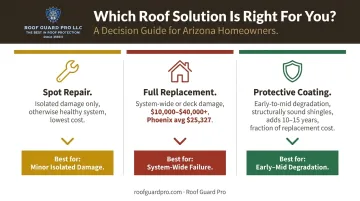
Professional protective coating is the middle path most homeowners don't know about. For the right candidate, it changes the economics of the decision entirely.
GoNano Shingle Saver: The Extend Option
Roof Guard Pro (ROC# 350311) is a certified applicator of GoNano Shingle Saver in the Phoenix East Valley, serving Mesa, Chandler, Gilbert, Scottsdale, and Tempe. The treatment replenishes the natural oils lost from shingles and permanently protects them from further UV degradation. Unlike surface coatings, it penetrates deep into the asphalt matrix at a nanoparticle scale.
Key details:
- Single application — no recurring reapplication cycles
- Adds 10–15 years of usable life to structurally sound aging roofs
- 10-year GoNano manufacturer warranty on treated shingles
- Significantly less than full replacement — pricing is based on roof size and condition, with free onsite estimates at (480) 878-2238
The service fits roofs in the 12–20+ year range where shingles have lost their oils but haven't yet curled, lifted, or shed granules. For new roofs treated within 6–12 months of installation, it can extend effective life to 30–35 years total by preserving factory oils before they deplete.
Roof Guard Pro conducts an honest triage assessment and will not apply the coating to a roof that has already passed the point of restoration.
The Timing Caveat
Waiting too long eliminates the extend option entirely. Once shingles have physically failed — curled, lifted, or stripped of granules — no coating restores them. The assessment that determines which option applies needs to happen before that threshold, not after it.
A free onsite estimate from Roof Guard Pro is the clearest way to know which category your roof falls into.
Frequently Asked Questions
How often should you replace an asphalt shingle roof?
Most asphalt shingle roofs are replaced every 15–25 years depending on shingle type and climate, but replacement should be driven by a condition assessment rather than age alone. Annual inspections after year 15 are the most practical way to determine the right timing for your specific roof.
How can you tell if your shingles need replacing?
Look for widespread curling or cracking, significant granule accumulation in gutters, missing shingles, and water stains inside the attic. When multiple signs appear across the full roof surface simultaneously, full replacement is typically warranted rather than repair.
Why do asphalt shingles wear out?
UV radiation and sustained heat break down the asphalt binder that keeps shingles flexible. Once granules loosen and expose bare asphalt to direct sun, degradation accelerates — and poor attic ventilation compounds the damage by adding heat stress from below.
Do asphalt shingles last as long in Arizona as in other states?
No. Phoenix-area roofs routinely fall short of manufacturer warranty durations because of extreme UV intensity, sustained high heat, and daily thermal cycling. East Valley homeowners should start inspections earlier than warranty timelines suggest — those figures are based on moderate climates, not Arizona conditions.
Can you extend the life of asphalt shingles without replacing them?
Yes — for roofs with structurally sound decking and shingles in early-to-mid degradation, professional nanotechnology coatings like GoNano Shingle Saver can replenish lost oils and add 10–15 years of life. That window closes once structural damage sets in, so early assessment is the critical factor.
What's the lifespan difference between 3-tab and architectural shingles?
3-tab shingles typically perform for around 15–20 years, while architectural shingles deliver 20–30 years due to their thicker laminated construction. In Arizona's climate, that difference is more pronounced — architectural shingles represent meaningfully better long-term value despite a higher upfront cost.