Here's the reality: that "30-year" number on the package was never a promise about your roof's actual lifespan. It's a product classification, tested under lab conditions that rarely match real weather, real installation crews, or Arizona's brutal sun.
Many Phoenix East Valley homeowners see an aging shingle roof approaching that 30-year mark and assume full replacement is the only option. Often, it isn't. This guide breaks down what the "30-year" label really means, what actually shortens shingle life in Arizona's climate, and how to tell if your roof needs replacing or just needs help.
Key Takeaways
- The "30-year" label reflects a warranty class and lab rating, not a guaranteed lifespan
- Architectural shingles carry a 30-year benchmark, but real-world conditions often cut that short
- Arizona's extreme heat and UV exposure accelerate shingle aging faster than milder climates
- Roofs with intact structure can often be restored and extended by 10–15 years instead of replaced outright
What Does "30-Year Shingles" Actually Mean?
"30-year shingles" is industry shorthand for a product tier, mainly architectural (dimensional) shingles, backed by a manufacturer warranty period. It was never designed as a service-life countdown clock.
Warranty Period vs. Actual Lifespan
These are two different things, and manufacturers know it. A warranty covers material defects under specific conditions. It doesn't account for:
- Your local climate
- Installation quality
- Attic ventilation
- Ongoing maintenance (or lack of it)
InterNACHI's standard life-expectancy chart, a widely used benchmark in the inspection industry, assigns 3-tab shingles a 20-year planning life and architectural shingles a 30-year planning life — but explicitly notes these figures assume normal wear, recommended maintenance, and standard installation. Real-world conditions can push actual lifespan well outside that range.
Why Manufacturers Moved to "Lifetime" Warranties
Adding to the confusion: many manufacturers no longer even use the "30-year" term. Since 2011, GAF shifted its laminated shingle lines, including its popular Timberline products, to lifetime limited warranties for qualifying single-family homes, phasing out fixed 30- and 40-year terms entirely.
"Lifetime" in this context means as long as you own the home, not a promise the shingles will physically last that long. Most lifetime warranties also shift to a prorated payout schedule after the first several years, so practical protection shrinks well before the shingles themselves wear out.
Shingle Classification Basics
Most 30-year shingles are architectural (also called dimensional or laminated) shingles. Depending on the product line, they may carry a UL 2218 Class 3 or Class 4 impact rating:
- Class 3: passes a 1.75-inch steel ball drop from 17 feet
- Class 4: the highest rating, passing repeated 2-inch steel ball drops from 20 feet
These ratings measure impact resistance in a controlled lab test. They say nothing about wind performance or how long the shingle will last on your roof.
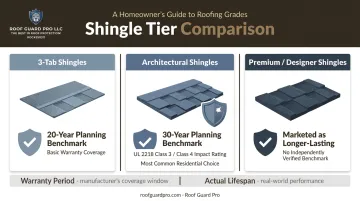
General shingle tier comparison:
| Shingle Type | Typical Planning Benchmark |
|---|---|
| 3-tab | ~20 years |
| 30-year architectural | ~20-30 years |
| Premium/designer | Marketed as longer-lasting, but no independently verified benchmark exists |
How Long Do 30-Year Shingles Really Last in Real-World Conditions?
Think of the 30-year figure as a ceiling, not an average. It represents best-case performance: quality installation, proper ventilation, moderate climate, and consistent maintenance. Most roofs don't get all four.
What actually determines where your roof lands in that range?
- Installation quality: nailing patterns, sealant application, flashing details
- Attic ventilation: heat buildup underneath accelerates aging from below
- Maintenance history: debris, granule loss, and minor damage compound over time
- Climate exposure: this is where Arizona changes the math entirely
Arizona's Desert Climate Factor
Arizona doesn't play by the same rules as a coastal or northern climate. Phoenix averages 111 days per year at or above 100°F, based on the National Weather Service's 1991-2020 normal, with the hot season typically running from early May through early October.
In 2020, that number hit 145 days, and one stretch in 2024 saw 113 consecutive days above the century mark.
That kind of sustained heat, layered with intense UV exposure, works against asphalt shingles in a way mild climates simply don't experience. Sun and heat dry out the oils that keep shingles flexible, and prolonged exposure accelerates granule loss, the mineral layer that provides UV protection in the first place.
The result: a shingle rated for a 30-year ceiling in a moderate climate often shows serious wear in Arizona well before that mark, especially without proactive care.
What Shortens 30-Year Shingle Lifespan Faster Than Expected?
Several factors compound to push shingles toward premature failure, regardless of what the product label says.
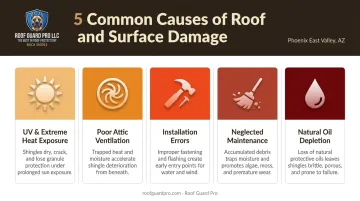
- UV and extreme heat exposure: Constant sun dries out asphalt oils, leading to brittleness, cracking, and accelerated granule loss. This is the single biggest culprit in Arizona.
- Poor attic ventilation: Trapped heat bakes shingles from underneath, causing blistering and curling from the inside out. The Asphalt Roofing Manufacturers Association identifies inadequate ventilation as a direct contributor to premature shingle deterioration.
- Installation errors: Overdriven, underdriven, or angled nails create weak points. Even premium shingles fail early if the nailing pattern was rushed or inadequate sealant was applied.
- Neglected maintenance: Ignoring minor granule loss, debris buildup, or small repairs lets small problems snowball into major deterioration.
- Natural oil depletion: As shingles age, they lose the oils that keep them flexible and resistant to UV damage. This is a gradual, predictable process, and one of the few factors homeowners can actually address before jumping to full replacement.
That last point matters more than most homeowners realize. Oil depletion is a treatable condition rather than structural failure. Catching it early can mean simple treatment instead of a full tear-off.
Signs Your Shingles May Be Reaching the End of Their Life
Not sure where your roof stands? Look for these warning signs:
- Excessive granule loss: noticeable buildup in gutters and downspouts signals the protective mineral layer is wearing away
- Curling, cracking, or blistering: shingles that feel brittle to the touch or visibly deform at the edges
- Fading: a dull, washed-out appearance compared to the original color
- Leaks or stains: dark spots, water marks, or active drips inside the attic or on ceilings
A single loose granule isn't a crisis; new shingles shed some naturally. But widespread granule loss combined with curling or fading is a different story, and it usually means the clock is running out on that section of roof.
Extend Your Roof's Life Without a Costly Full Replacement
Here's what a lot of homeowners don't realize: a roof 15+ years old isn't automatically a lost cause. If the shingles still lie flat, haven't curled or lifted, and haven't lost significant granule structure, the underlying material may still have plenty of usable life left. It just needs the oils replaced.
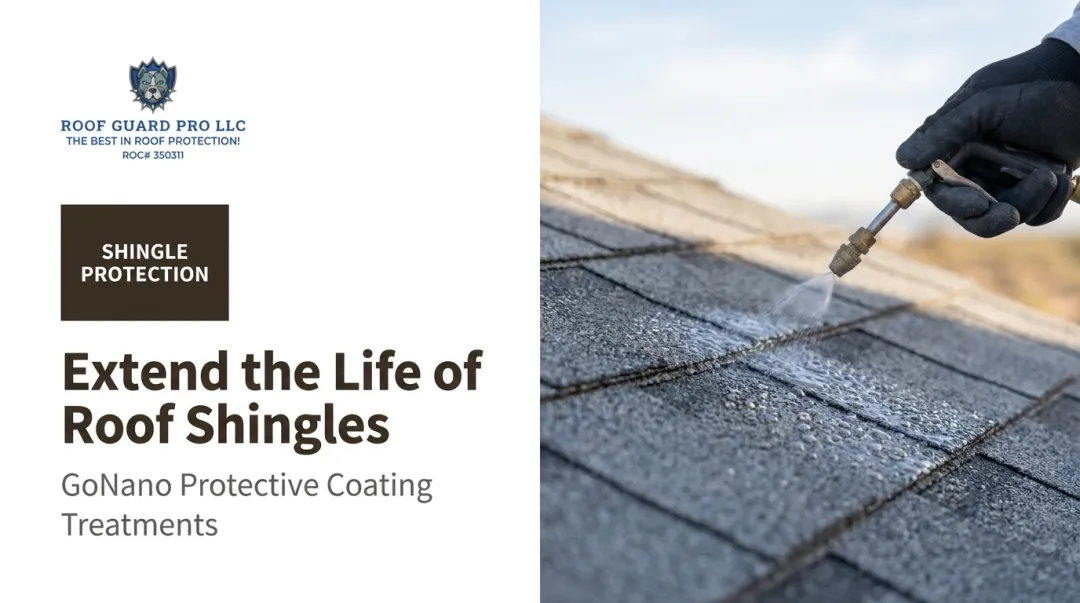
That's the gap Roof Guard Pro's GoNano Shingle Saver is built to fill. It's a certified nanotechnology treatment, professionally sprayed across the entire shingle surface, that penetrates deep into the asphalt pores rather than sitting on top like a traditional sealant. Once applied, it:
- Replaces the natural oils shingles lose to age and sun exposure
- Creates a permanent, hydrophobic barrier against UV rays and moisture
- Stops further granule loss and helps restore flexibility
A single application is designed to add 10-15 years of usable life, backed by a 10-year GoNano manufacturer warranty.
The Cost Comparison
A typical Arizona full re-roof runs $10,000 to $40,000+, depending on size and materials. A Shingle Saver application costs a fraction of that, priced per roof based on square footage and current shingle condition, since every property is different.
Not every roof qualifies, though. Roof Guard Pro runs a free onsite assessment first, checking for curling, lifting, and granule loss before recommending treatment. If a roof has already deteriorated past the point of restoration, they'll say so upfront rather than coating a roof that's already failing.
If you're in Mesa, Chandler, Gilbert, Scottsdale, or Tempe and staring down what looks like an expensive re-roof decision, it's worth finding out first whether your roof actually needs one. Schedule a free onsite roof assessment with Roof Guard Pro (ROC# 350311) before committing to full replacement.
Frequently Asked Questions
How often should you replace shingles on your roof?
Most shingle roofs are replaced somewhere between 20 and 30 years, depending on material quality, climate, and maintenance history. Many roofs, however, can have their usable life extended with proper treatment well before replacement becomes necessary.
Can you sell a house with a 30-year old roof?
Yes, homes with older roofs sell regularly. Buyers, lenders, or insurers may require an inspection first, and could ask for repairs, credits, or restoration if the roof shows significant wear.
What class is a 30-year architectural shingle?
Most 30-year shingles are architectural (dimensional) shingles, commonly rated Class 3 or Class 4 for impact resistance under UL 2218 testing, depending on the specific product and manufacturer.
Do 30-year shingles actually last 30 years?
Rarely, in practice. The 30-year figure represents warranty coverage and best-case lab conditions, not a guarantee. Real-world lifespan depends heavily on installation quality, ventilation, and local climate exposure.
Is it cheaper to repair, restore, or replace an aging shingle roof?
Restoration treatments like Roof Guard Pro's GoNano Shingle Saver typically cost a fraction of full replacement and make sense when the roof still has structural integrity. Full replacement becomes necessary once shingles have curled, lifted, or lost significant granule structure.
How can I tell if my roof still has usable life left?
A professional inspection is the most reliable way, checking for granule loss, curling, leaks, and oil depletion. A free onsite estimate from Roof Guard Pro can determine quickly whether restoration is a realistic option for your roof.