The problem is that UV degradation is invisible until it isn't. By the time you see cracking, cupping shingles, or granules collecting in your gutters, the damage has been building for years. That's what makes it one of the most underestimated causes of early roof failure.
This guide covers exactly what UV radiation does to asphalt shingles, why the financial stakes are higher than most homeowners realize, and how proactive protection changes the equation.
Key Takeaways
- UV rays oxidize asphalt oils, causing shingles to become brittle, crack, and shed granules
- A standard roof replacement costs an average of $30,680 — UV protection is a fraction of that
- UV damage is not covered by most homeowners insurance policies
- South- and west-facing slopes face accelerated UV exposure and age faster than other roof areas
- A single GoNano Shingle Saver application can add 10–15 years to your roof's lifespan
- Roof Guard Pro backs every treatment with a 10-year manufacturer's warranty
What UV Radiation Actually Does to Your Roof
UV radiation sits in a part of the solar spectrum you can't see, but its effects on roofing materials are very real. There are two types worth understanding: UV-A (320–400 nm) and UV-B (280–320 nm). Research on asphalt binders shows the strongest aging effects occur around 300–350 nm — squarely in UV-B territory — through a process called photo-oxidation.
How Photo-Oxidation Breaks Down Shingles
Asphalt shingles hold together because of oils and resins within the asphalt binder. UV exposure causes those oils to oxidize and gradually evaporate — the same process that turns unprotected leather stiff and cracked. Once the binder dries out, shingles lose their flexibility and become brittle.
According to research published in the journal Solar Energy Materials and Solar Cells, even three-year weathering studies show measurable changes in solar reflectance associated with oil loss and photo-oxidation of exposed asphalt.
The granule layer on top of shingles — ceramic-coated mineral particles — is what ARMA describes as providing UV protection, durability, and longevity. When shingles dry out, granules shed faster. And once granules are gone, the raw asphalt beneath absorbs UV and heat directly, accelerating deterioration further.
UV vs. Heat: Related But Different
UV and heat damage are often conflated, but they work differently. UV drives photo-oxidation of the asphalt binder. Heat drives thermal load and surface temperature. Research from ORNL/ASHRAE found that a conventional dark asphalt shingle reached approximately 160°F at solar noon — a temperature that compounds UV-driven oil loss significantly.
That combination — UV photodegradation accelerated by high surface temperatures — is exactly why geography matters. UV exposure isn't uniform across a roof:
Where UV Damage Hits Hardest
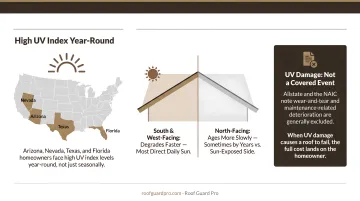
- South- and west-facing slopes receive the most direct daily sun and degrade faster
- Arizona, Nevada, Texas, and Florida homeowners face high UV index levels year-round, not just seasonally
- North-facing slopes age more slowly — sometimes by years compared to sun-exposed sides of the same roof
UV damage is also not a covered event under most homeowners insurance policies. As Allstate and the NAIC both note, wear-and-tear and maintenance-related deterioration are generally excluded. When UV damage causes a roof to fail, the full cost lands on the homeowner.
The Real Advantages of UV Roof Protection
Advantage 1: Extends Your Roof's Functional Lifespan
UV protection has one primary payoff: your roof lasts longer.
NRCA states that most new roofs are designed to provide useful service for about 20 years, though actual lifespan depends heavily on materials, environment, and maintenance. In high-UV climates, that timeline can compress significantly without intervention.
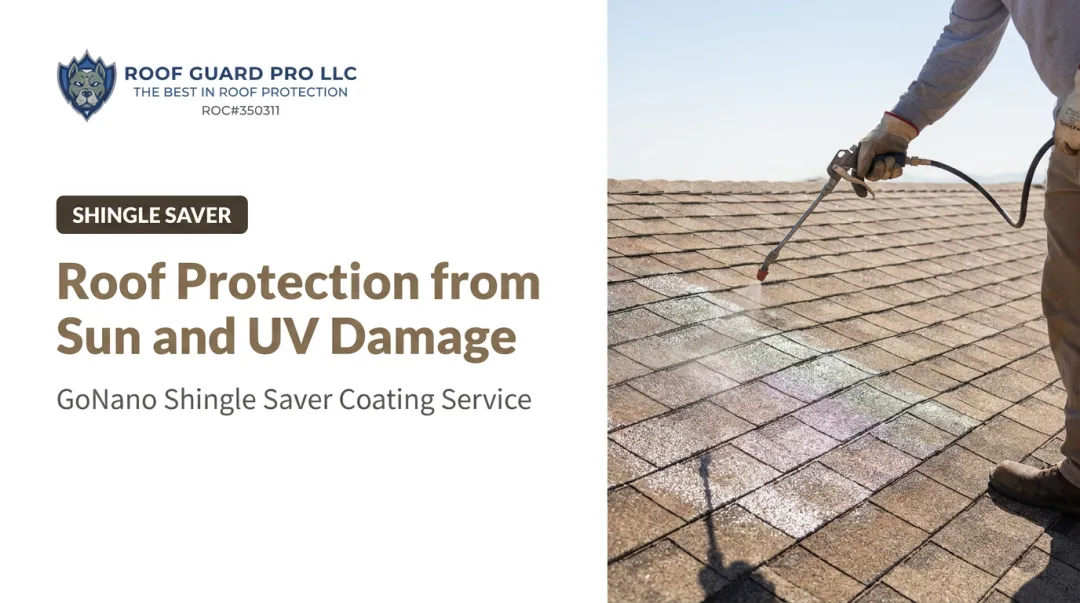
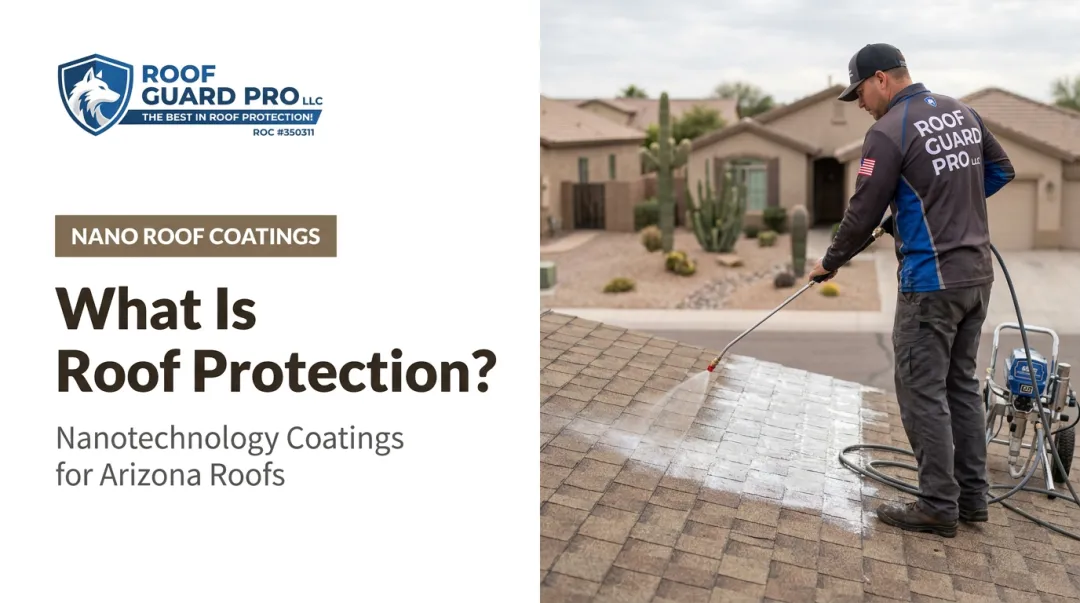
Standard UV protection products add a surface barrier to reflect or absorb UV rays. Advanced formulations go further. Roof Guard Pro's GoNano Shingle Saver uses nanotechnology — specifically nanosilica particles small enough to penetrate deep into asphalt pores rather than sitting on the surface. This allows the product to actively replace the oils UV exposure has depleted, restoring flexibility rather than just sealing the exterior. The technology is grounded in nanosilica-modified asphalt research recognized by the American Society of Civil Engineers.
A single application can add 10–15 years to a roof's lifespan, backed by a 10-year manufacturer's warranty.
Who benefits most from this:
- Roofs that are mid-life but still structurally sound (typically 10–15 years old)
- South- and west-facing roofs with maximum daily sun exposure
- Homeowners in Arizona and other high-UV sunbelt states where degradation timelines are compressed
Advantage 2: Reduces Long-Term Maintenance and Replacement Costs
UV damage to shingles doesn't stay contained to the shingles. Once shingles crack or curl, water gets in. Water infiltration leads to damaged roof decking, attic moisture problems, insulation degradation, and eventually interior leaks. Each stage of that damage cycle adds cost — and UV protection stops it before it starts.
According to the 2024 JLC/Remodeling Cost vs. Value Report, the national average cost for a residential asphalt-shingle roof replacement is $30,680 — and that's for a planned, scheduled replacement. Emergency replacements carry premium contractor pricing on top of that. Meanwhile, water damage claims average $15,400 per incident according to III data.
A professionally applied UV treatment, like GoNano Shingle Saver from Roof Guard Pro, is a fraction of either figure and defers the replacement timeline by a decade or more. The 10-year manufacturer's warranty gives homeowners a concrete, verifiable guarantee — not just a sales claim.
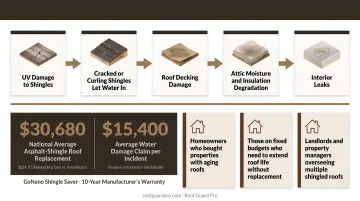
This matters most for:
- Homeowners who bought properties with aging roofs
- Those on fixed budgets who need to extend roof life without replacement
- Landlords and property managers overseeing multiple shingled roofs
Advantage 3: Supports Home Energy Efficiency
Dark, granule-depleted shingles absorb more solar heat than protected shingles with intact granule coatings. That heat transfers into your attic, raising indoor temperatures and increasing cooling loads.
The ORNL/ASHRAE research measured a standard asphalt shingle at solar reflectance of just 0.093 — meaning it reflects less than 10% of incoming solar radiation and absorbs the rest. Cooler-performing shingles with reflectance of 0.25 showed cooling-energy savings of 4.5–6.2% in warm California climates. The DOE estimates cool roofs can reduce cooling costs by 5–20% in warm climates.
For Arizona homeowners, where cooling season runs most of the year, that thermal load is a real cost driver. GoNano Shingle Saver preserves the granule layer and includes heat resistance as a documented product property, helping maintain roof surface reflectance and reduce that load over time.
Best fit for:
- Homeowners in hot climates with long cooling seasons (Arizona homeowners especially)
- Homes with inadequate attic insulation
- Properties where HVAC efficiency is already a concern
What Happens When UV Protection Is Ignored
Neglect has a predictable timeline. The first signs appear gradually: granules accumulating in gutters, shingles that look faded or slightly cupped at the edges. These are easy to dismiss as cosmetic.
They're not cosmetic. They signal that the asphalt binder — the material that holds shingles together — has already lost meaningful oil content and the shingle structure is weakening. Once that process starts, it doesn't stop on its own.
Left unaddressed, the progression looks like this:
- Granule loss accelerates — bare asphalt patches become visible on the roof surface
- Shingles curl and crack — edges lift, creating entry points for water
- Water infiltration begins — decking, insulation, and interior finishes are next
- Emergency replacement becomes necessary — on a timeline you didn't choose, with no opportunity to budget
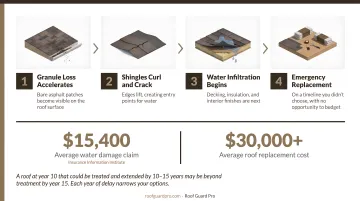
The cost contrast between proactive and reactive decisions is significant. According to the Insurance Information Institute, water damage claims alone average $15,400. That's in addition to roof replacement costs averaging over $30,000.
UV damage also has a shrinking window for cost-effective intervention. A roof at year 10 that could be treated and extended by 10–15 years may be beyond treatment by year 15. Each year of delay narrows your options — and the return on any investment in protection.
How to Get the Most Value from UV Roof Protection
A few practical principles apply regardless of which protection product or provider you choose:
Act before damage becomes extensive. GoNano Shingle Saver replenishes oils within the shingle — but that requires shingles with enough structural integrity to benefit. Waiting until shingles are severely cracked or curling means treatment stabilizes existing damage rather than preventing further decline.
Get a professional assessment first. Roof Guard Pro offers free estimates so a qualified professional can evaluate your roof's condition and confirm it's a viable candidate for treatment. Not every roof qualifies — and knowing that early saves money either way.
Treat protection as ongoing maintenance, not a one-time fix. GoNano Shingle Saver is a single-application solution backed by a 10-year manufacturer's warranty. As that window approaches, contact Roof Guard Pro to review your options for continued coverage.
Annual inspections in the interim help catch granule loss or early wear before it compounds.
These principles matter everywhere, but they carry extra weight in Arizona. UV index levels here stay elevated year-round — there's no off-season for roof degradation. Roof Guard Pro (ROC# 350311) serves the Phoenix metro area, applying GoNano Shingle Saver treatments to both aging and newer shingled roofs.
Conclusion
UV radiation is not a dramatic threat. There's no wind, no hail, no sudden damage event. It's just the sun, working on your shingles every day, depleting the oils that keep them flexible and intact.
That consistency is exactly what makes it dangerous. By the time UV damage becomes visible, the degradation has already been compounding for years — and the financial consequences of ignoring it are disproportionately large compared to the cost of addressing it proactively.
UV protection extends roof life and reduces long-term maintenance costs. In Arizona's intense sun, it can also make a measurable difference in cooling efficiency. The homeowners who get the most out of their roofs treat UV defense as routine upkeep — scheduling it before damage sets in, not after granule loss and cracking force the issue.
If your shingles are losing flexibility or showing early signs of UV wear, a professional nano-coating treatment can restore the oils UV strips away and add years back to your roof's lifespan — without a full replacement.
Frequently Asked Questions
Do roofs block UV?
Standard asphalt shingles don't block UV — they absorb it. The granule layer provides meaningful UV protection when intact, but the asphalt beneath is still subject to ongoing photo-oxidation. UV protection treatments are needed to actively defend shingle materials against UV-induced breakdown.
What blocks 100% of UV rays?
No standard roofing material blocks 100% of UV. For asphalt shingles specifically, the goal isn't full blockage — it's limiting UV absorption and replenishing the oils that UV exposure depletes over time. Protective coatings are the most practical way to slow that process.
How does UV radiation damage asphalt shingles specifically?
UV rays oxidize the asphalt oils that keep shingles flexible. Once depleted, shingles become brittle, curl, crack, and shed granules — exposing raw asphalt to even more intense UV and heat. The cycle accelerates once granule loss begins.
How can I tell if my roof has UV damage?
Look for granules accumulating in gutters or at downspout exits, shingles that appear faded or are cupping at the edges, dark patches where granules are missing, and visible cracking on shingle surfaces. Any of these signs warrant a professional roof assessment.
Does UV roof damage happen faster in certain climates?
Yes. Roofs in high-UV regions — the American Southwest, Southeast, and other sunbelt states — face elevated UV index levels year-round rather than seasonally. Arizona homeowners in particular deal with some of the most intense sustained UV exposure in the country, making proactive protection especially important.
Is it worth treating a roof for UV protection, or should I just replace it?
If the roof structure is intact and shingles haven't reached end-of-life failure, a professional UV protection treatment typically costs a fraction of full replacement — which routinely exceeds $30,000 for residential roofs. A free professional assessment from Roof Guard Pro will confirm whether your roof is a viable candidate for treatment.