Introduction
Getting a roof replacement quote can stop you cold. According to HomeAdvisor's 2025 data, the national average sits at $9,602 — and that's before deck rot, structural repairs, or permit fees push the number higher. For many homeowners, that figure lands somewhere between "painful" and "impossible."
A full replacement is often avoidable. From nano-coating shingle treatments and targeted repairs to overlay systems and ventilation upgrades, several alternatives can add meaningful years to a roof's life at a fraction of the cost.
The 10 options below are ordered from least invasive and lowest cost to more involved solutions, so you can quickly find the right starting point for your situation.
Key Takeaways
- Full roof replacement averages around $9,600, but many roofs qualify for lower-cost alternatives
- Alternatives include shingle rejuvenation, targeted repairs, metal overlays, and algae removal
- The right choice depends on your roof's age, the extent of damage, and remaining material integrity
- Most alternatives deliver the best results when applied before damage spreads
- Start with a professional inspection to determine which option fits your roof
Why Roof Replacement Costs So Much
Full replacement isn't a single expense — it's six or seven costs stacked together:
- Tear-off and disposal: Removing old shingles adds $1,500–$4,500 alone
- Labor: Typically 15%–25% of the total project cost
- Underlayment: Around $2–$3 per square foot
- New shingles: The material cost itself
- Permits: $100–$1,400 depending on your jurisdiction
- Deck repairs: If rot is present, add another $1,000–$10,000
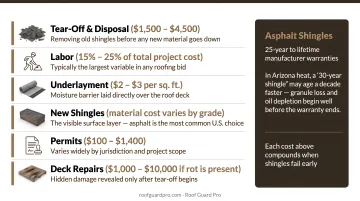
Asphalt shingles are the most common residential roofing material in the U.S., carrying manufacturer warranties of 25 years to lifetime. In practice, UV exposure and heat cause them to age faster than those numbers suggest. In climates like Arizona, thermal stress and intense sun accelerate granule loss and oil depletion — shortening a "30-year shingle" by a decade or more.
That shortened lifespan is what makes the alternatives below worth knowing. Each one targets a specific point in that cost stack.
10 Cost-Effective Roof Replacement Alternatives
1. Nanotechnology-Based Shingle Rejuvenation Treatment
Asphalt shingles lose their petrochemical oils over time due to UV exposure and heat. When those oils go, shingles become brittle, prone to cracking, and increasingly vulnerable to granule loss — which removes their last line of UV protection.
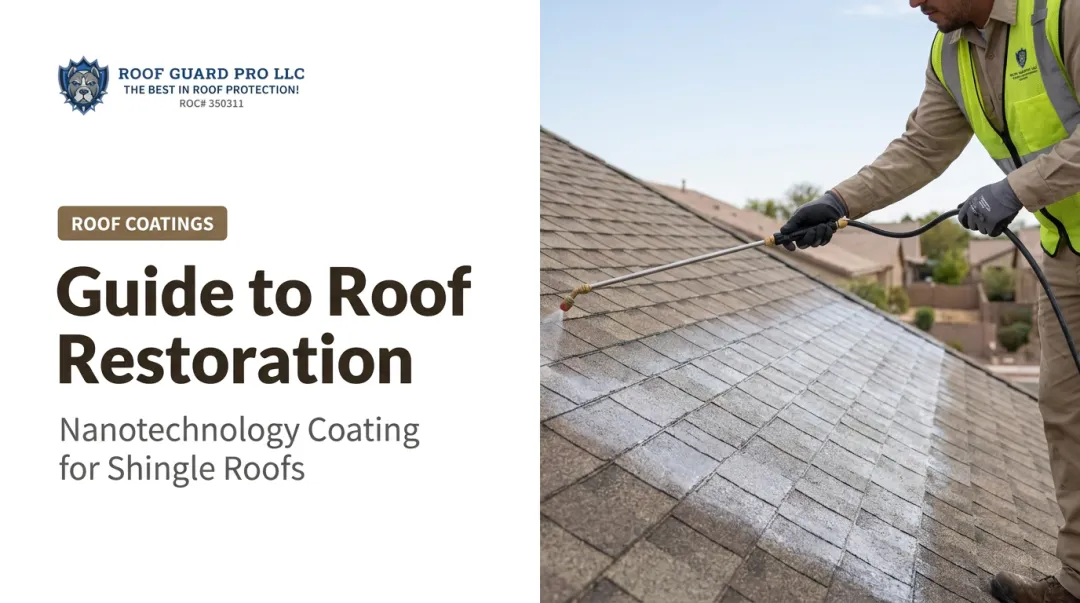
Roof Guard Pro's GoNano Shingle Saver addresses this at the source. Using nanosilica-modified asphalt technology, the treatment penetrates deep into shingle pores rather than sitting on the surface like conventional silicone or acrylic coatings. This deep penetration restores flexibility and UV resistance from within. Research on nanosilica-modified asphalt binders, recognized by the American Society of Civil Engineers (ASCE), confirms the mechanism.
One professional application adds 10–15 years to a roof's life and comes with a 10-year manufacturer's warranty. The treatment works on both aging roofs (15+ years old) and newer roofs used as a preventative measure. In Arizona's high-UV climate, the combination of oil restoration and UV barrier protection makes this particularly well-suited.
Pricing is available through a free estimate. As a reference point, a GoNano treatment costs a fraction of the $9,600+ national average for full roof replacement.
2. Targeted Shingle and Flashing Repairs
A few cracked shingles, dried caulk around a vent stack, or loose flashing near the chimney don't justify full tear-off. A licensed roofer can address these areas individually at a fraction of total replacement cost:
| Repair Type | Typical Cost |
|---|---|
| Patch repair / shingle replacement | $100–$1,000 |
| Asphalt shingle repair average | $875–$975 |
| Flashing repair or replacement | $150–$1,000 |
| General roof repair average | $1,150–$1,171 |
Compared to a $5,900–$13,368 full replacement, targeted repairs are materially cheaper — provided the damage is isolated and the decking beneath is sound. If granule loss is widespread or the deck feels soft in multiple spots, repairs alone won't hold.
3. Roof Leak Repair
Most leaks originate at seams, vent boots, or flashing joints — not across the entire roof surface. Targeted leak repair typically runs $360–$1,550, focusing only on the vulnerable area without touching intact sections.
The urgency here matters. GAF warns that unresolved leaks escalate into rotten decking, mold, compromised insulation, and structural damage — and that repair costs increase the longer a leak goes unaddressed. A $500 repair caught early can prevent a $5,000 deck replacement later.
4. Roof Ventilation Upgrade
Poor attic ventilation traps heat and moisture, accelerating shingle aging from below. The Asphalt Roofing Manufacturers Association (ARMA) confirms that heat buildup from inadequate ventilation speeds weathering and reduces roof service life — a critical issue in hot climates where thermal stress is already working on shingles from above.
The IRC sets a minimum ventilation standard of 1/150 of vented space area. Upgrading to meet or exceed that benchmark — through ridge vents, soffit vents, or powered attic ventilators — can slow granule loss and extend shingle life noticeably.
Ridge vent installation runs $300–$650 on average. When combined with a surface treatment like GoNano Shingle Saver that addresses UV stress from above, the two approaches target shingle aging from both directions.
5. Algae and Moss Removal
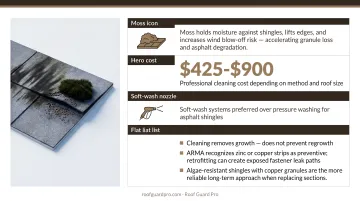
Gloeocapsa magma — the algae species behind dark roof streaking — doesn't typically damage shingles on its own. Moss is the bigger problem: it holds moisture against the shingle surface, lifts edges, and increases wind blow-off risk. Left unchecked, it accelerates granule loss and asphalt degradation.
Professional cleaning runs $425–$900 depending on method and roof size. Soft-wash systems are generally preferred over pressure washing for asphalt shingles.
A few things to know before proceeding:
- Cleaning removes growth; it doesn't prevent regrowth
- ARMA recognizes zinc or copper strips as preventative measures but notes retrofitting them can create exposed fastener leak paths
- Algae-resistant shingles with copper granules are the more reliable long-term approach when replacing sections
6. Ridge Cap Repair or Replacement
The roof ridge is the highest point on a gabled roof and the most vulnerable to water infiltration and wind uplift. When ridge caps crack, shift, or go missing, that peak seam becomes a direct pathway for moisture.
Replacing just the ridge cap is one of the most targeted, lowest-cost interventions available. It protects the most structurally critical seam without touching the rest of the roof.
This repair makes sense when:
- Ridge caps show cracking, curling, or gaps
- Field shingles below remain structurally sound
- Wind uplift has dislodged individual caps without broader damage
If those conditions apply, ridge cap replacement alone can meaningfully extend overall roof life.
7. Roof Recover (Overlay New Shingles Over Old)
Building codes in many jurisdictions permit installing one new layer of shingles directly over an existing single layer, skipping tear-off entirely. Angi reports tear-off alone costs $1.20–$4.00 per square foot, so eliminating that step produces real savings.
A recover is viable when:
- The existing shingles lie flat (no buckling or significant curling)
- The deck is structurally sound with no soft spots
- Only one layer of roofing is currently in place
- Local code permits it (IRC R908.3.1.1 prohibits recover over two or more existing layers or deteriorated coverings)
One important note: most manufacturers do not recommend recovering over laminated (architectural) shingles. Confirm compatibility with both your local code and your shingle manufacturer before proceeding.
8. Partial Roof Replacement
When only one section — typically a south-facing slope that has absorbed years of direct UV — is severely deteriorated while the rest of the roof remains intact, a contractor can replace that section alone. Both material and labor costs drop compared to a full tear-off.
The main trade-off is shingle matching. GAF notes that color codes, production dates, and packaging lines all affect shading — visual matching alone is unreliable because aging changes shingle appearance.
Before committing, confirm:
- Your contractor can source shingles from the same production line or color code
- The age gap between old and new sections won't create obvious visual contrast
- The remaining sections don't show early signs of the same deterioration
If the rest of the roof is within a few years of the same failure point, a full replacement may be more economical than two partial jobs.
9. Metal Roof Overlay System
Metal overlay systems install directly over existing shingles without tear-off. Lightweight steel or aluminum panels add weather resistance and longevity without requiring a full replacement of the underlying structure.
Key facts on metal overlays:
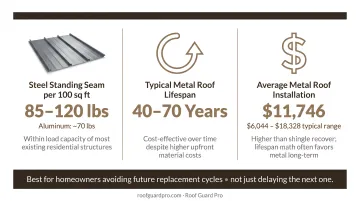
- Steel standing seam weighs roughly 85–120 lbs per 100 sq ft; aluminum runs about 70 lbs — well within the load capacity of most existing residential structures
- Metal roofs typically last 40–70 years, making them cost-effective over a longer time horizon despite higher upfront material costs
- General metal roof installation averages $11,746 with a range of $6,044–$18,328 — higher than a shingle recover, but the lifespan math often favors metal for homeowners planning long-term
This option makes the most sense for homeowners who want to avoid future replacement cycles rather than just delay the next one.
10. Alternative Roofing Materials (When Replacement Is Unavoidable)
Sometimes replacement is genuinely unavoidable. When that's the case, longer-lasting materials reduce the frequency of future replacements:
| Material | Cost Per Sq Ft | Lifespan |
|---|---|---|
| Synthetic composite shingles | $4–$8 | 30–50 years |
| TPO membrane (flat roofs) | $4.50–$16 | 15–30 years |
| EPDM rubber membrane (flat roofs) | $4.25–$12 | 30–40 years |
Synthetic composite shingles mimic slate or wood at lower weight and installation cost. TPO and EPDM membranes are designed for flat or low-slope residential applications. All three options cost more upfront than standard asphalt shingles but reduce lifetime replacement frequency — which is where the real cost savings accumulate.
When Do You Actually Need a Full Roof Replacement?
Alternatives work well — but only within a specific window. Once certain conditions exist, no coating, overlay, or repair will change the math. These are the signs that point toward replacement:
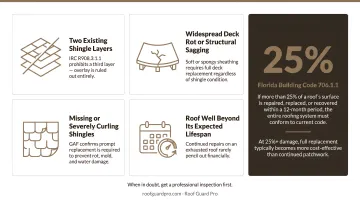
- Two existing shingle layers already in place: a third layer is prohibited under IRC R908.3.1.1, which rules out overlay entirely
- Widespread deck rot or structural sagging: soft or spongy sheathing requires full deck replacement regardless of shingle condition
- Missing or severely curling shingles across most of the surface: GAF confirms this requires prompt replacement to prevent rot, mold, and water damage
- A roof well beyond its expected lifespan: continued repairs on an exhausted roof rarely pencil out financially
The 25% rule is worth understanding, though it's not a universal national standard. Florida Building Code 706.1.1 codifies it: if more than 25% of a roof's surface is repaired, replaced, or recovered within a 12-month period, the entire roofing system must conform to current code requirements. Many roofing professionals use this as a practical tipping point — at 25%+ damage, full replacement usually becomes more cost-effective than continued patchwork.
When in doubt, get a professional inspection first. An experienced roofer can assess whether the remaining shingles have enough structural integrity to benefit from any of the alternatives above — and give you a clear recommendation before you spend money on a short-term fix.
Conclusion
Most homeowners who receive a replacement quote have at least one lower-cost alternative available. The key is acting before damage spreads beyond the point where alternatives are viable — and getting a professional assessment before committing to any path.
If your roof is aging but structurally intact, Roof Guard Pro's GoNano Shingle Saver offers a nanotechnology-based treatment that restores lost shingle oils, blocks UV damage, and adds 10–15 years to your roof's life — backed by a 10-year manufacturer's warranty. For Arizona homeowners dealing with intense sun and heat cycling, that protection makes a measurable difference.
To find out if your roof qualifies, reach out to Roof Guard Pro for a free estimate. Call (480) 878-2238 or email info@roofguardpro.com — estimates are available Monday through Friday, 9 a.m.–5 p.m.
Frequently Asked Questions
What can I do if I can't afford to replace my roof?
Start with targeted repairs for isolated damage — missing shingles or failed flashing can often be fixed for $150–$1,000. A professional shingle rejuvenation treatment is another cost-effective option for aging but structurally sound roofs. Check your homeowner's insurance policy as well; storm or hail damage is often partially covered.
What is the 25% rule for roofing?
The 25% rule is a building code provision stating that if more than 25% of a roof's surface is repaired or replaced within 12 months, the entire roofing system must meet current code standards. Many roofing professionals use it as a practical threshold for when full replacement becomes more cost-effective than ongoing repairs. Requirements vary by state and municipality, so check your local code.
What can I use instead of shingles?
Common alternatives include metal panels, synthetic composite shingles, concrete or clay tiles, and single-ply membranes (TPO or EPDM) for flat roofs. The best fit depends on your climate, budget, and structural load capacity — heavier tile materials aren't compatible with every roof frame.
How long can you extend the life of a roof without replacing it?
With proactive maintenance — professional shingle treatments, ventilation upgrades, and timely repairs — many asphalt roofs can realistically gain 10–15 years beyond their expected lifespan. The earlier those interventions happen, the more effective they are.
Is it better to repair or replace a roof?
Repair is the better choice when damage is localized and the roof is mid-life with sound decking. Replacement makes more sense when damage is widespread, two shingle layers are already present, or the roof has exceeded its expected lifespan by several years.
Can you put new shingles over old ones?
Yes — one new layer of asphalt shingles can typically be installed over a single existing layer, provided the existing shingles lie flat, the deck is structurally sound, and local building codes permit it. This is called a roof recover and eliminates tear-off costs. It's not an option if two layers are already in place.